
Last updated: September 2, 2026
I picked up the PRGR launch monitor a couple of years ago — nearly 100% to run Stack System speed-training sessions and to have something portable I could throw in a bag for a range trip. Since I also own a Foresight GC3, I did the obvious thing: put them side by side and recorded every shot on both units.
Two years and a lot of sessions later, the PRGR is still the launch monitor I recommend to golfers who want ball speed and clubhead speed data without the $2,000+ price tag. Nothing in the sub-$300 pocket radar market has moved past it in 2026. Here’s the full breakdown — including the 30-shot head-to-head vs the GC3, where the PRGR falls short on distance, and how it stacks up against the Garmin R10 and Swing Caddie SC200.
Quick Verdict: 4.5 / 5
Best for: Golfers who want accurate clubhead speed and ball speed for speed training, range calibration, or a home hitting net — without paying $2k+.
Skip it if: You need launch angle, spin rate, or simulator play. The PRGR doesn’t measure those and never will — it’s a Doppler radar, not a photometric or dual-radar system.
Current price (2026): around $199–249 depending on the retailer. Bundles with The Stack System and SuperSpeed Sticks knock ~10% off.
What the PRGR Measures (and What It Doesn’t)
The PRGR HS-130A is a Doppler-radar pocket launch monitor made by Yokohama Rubber (the golf division). It sits about 4.5 feet behind the ball and captures data through the swing and impact zone.
What it measures directly:
- Clubhead speed (mph)
- Ball speed (mph)
What it calculates from those two measurements:
- Smash factor (ball speed ÷ clubhead speed)
- Carry distance (derived from ball speed + assumed launch/spin)
- Total distance (carry + assumed roll)
That’s 5 data points on the readout — but only 2 of them are actually measured. The rest are the PRGR’s best guess based on assuming your launch angle and spin rate are optimal. Which they usually aren’t. More on that below.
PRGR HS-130A Specs and Price
| Spec | Value |
|---|---|
| Model | PRGR Black Pocket Launch Monitor (HS-130A) |
| Manufacturer | Yokohama Rubber (Japan) |
| Technology | Doppler radar |
| Data measured | Clubhead speed, ball speed |
| Data calculated | Smash factor, carry distance, total distance |
| Display | Built-in LCD (no phone required) |
| App required | No |
| Bluetooth / Wi-Fi | No |
| Battery | 4× AAA (not included) |
| Memory | Last 500 swings |
| Dimensions | 3.03″ L × 1.69″ W × 5.63″ H |
| Weight | Under 5 oz (4.4 oz) |
| Left- and right-handed | Yes, both |
| Simulator support | No |
| Weather resistance | Not weather sealed — keep it dry |
| Also works for | Baseball (pitch + bat speed), tennis serve, soccer, hockey |
| Price (2026, USA) | ~$199–249 (Amazon, Top Shelf Golf, retailer varies) |
My Head-to-Head Test: PRGR vs Foresight GC3
Every review of a sub-$300 launch monitor eventually gets to the question “yeah but is it accurate?” Most of the top-ranking PRGR reviews online cite an “independent TrackMan comparison” without showing the data.
Here’s what I did instead: I ran 30 shots side by side — 10 shots each with a driver, a 7-iron, and a wedge — with the PRGR positioned about 4.5 feet behind the ball and the Foresight GC3 (roughly an $8,000 photometric launch monitor) positioned as it normally sits in my hitting bay. Same swing, same ball, both units capturing simultaneously.
The averages by club:
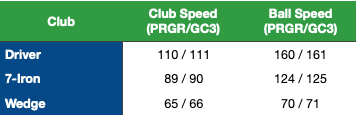
The result: 1 mph average difference across all 30 shots. Not “close to.” Not “within a reasonable margin.” Every single shot came out within 1 mph on both clubhead speed and ball speed. The 10 driver shots averaged 1 mph apart. The 10 seven-iron shots averaged 1 mph apart. The 10 wedge shots averaged 1 mph apart.
For context on why that matters: the GC3 uses stereoscopic high-speed cameras and is used by tour players for club fitting. If the PRGR at $199 can hang with it inside 1 mph on the two metrics it’s actually measuring, that’s a serious result. This is the number the PRGR was built to deliver, and it delivers.
PRGR Alignment Discovery — 10% Error When Off-Axis
Working with the PRGR over the last two years, one thing surfaced that nobody else’s review mentions: if the device is off-axis from your actual clubhead path, the readings drop by roughly 10%. Line it up along your target line but swing on an in-to-out or out-to-in path relative to the unit and you’ll see clubhead speeds pulled 8–12 mph lower than reality.
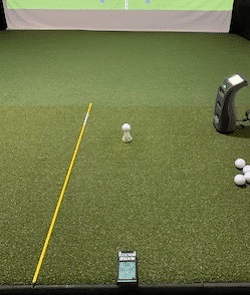
Good alignment — placed square behind the ball, aligned on the swing path
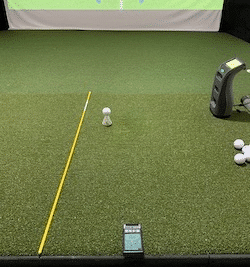
Bad alignment = roughly 10% under-read on clubhead speed
The fix is simple: eyeball the alignment before every session, and check periodically if you’re moving the unit around. The reason the PRGR “reads slow” for some users is almost always this — it’s a device issue, not a technique issue. When it’s aligned, it’s within 1 mph of an $8,000 launch monitor.
Where the PRGR Falls Short: Distance Is Calculated, Not Measured
Now the honest part. The PRGR’s clubhead speed and ball speed are excellent. Its distance readings are a rough guess.
Higher-end launch monitors calculate carry distance using ball speed, launch angle, spin rate, and environmental factors like altitude, temperature, and wind — that’s the formula from Foresight PEAK, the training program for professional launch monitor fitters.
The PRGR can’t measure any of those inputs. It has one Doppler radar emitter reading speed. That’s it. So the distance number on the readout is derived from ball speed alone, assuming a well-optimized launch angle and spin rate.
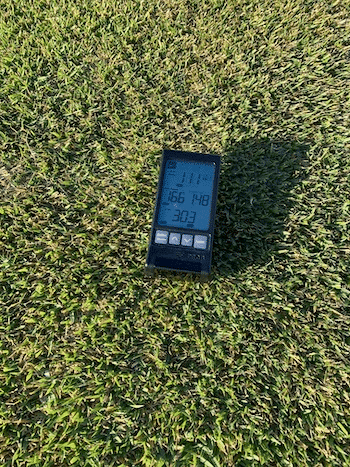
Here’s the concrete example: The screenshot above is from an actual drive I hit on the 3rd tee at my home course. The PRGR read 303 yards. The ball rolled to a stop at 270. That 33-yard gap is because I was hitting into the wind — a real-world factor the PRGR can’t see. It saw a fast ball speed and assumed optimal spin/launch/wind, then output the number that would have produced in a wind tunnel.
The takeaway isn’t “the PRGR lies about distance.” It’s “the PRGR gives you the theoretical maximum carry your ball speed could produce under ideal conditions.” If your launch and spin are dialed in and there’s no wind, the number is close. If your launch is scoopy or the wind is up, the number overshoots what happens in the real world.
For speed training and range calibration, this doesn’t matter — you’re not there for the distance number. For estimating on-course distances, the PRGR readout is optimistic. Trust your on-course numbers, not the PRGR’s derived carry.
PRGR vs Swing Caddie SC200 vs Garmin R10 vs Foresight GC3
Nobody else’s review can put all four of these units side by side because nobody else owns them all. Here’s how the PRGR stacks up across the main comparison points at the 2026 price points:
| Feature | PRGR HS-130A | Swing Caddie SC200 | Garmin R10 | Foresight GC3 |
|---|---|---|---|---|
| Price (2026) | ~$199–249 | ~$249–279 | ~$499–599 | ~$8,000 |
| Data measured | 2 (clubhead + ball speed) | 2 (ball speed + est. carry) | 4 (ball speed, club speed, direction, apex height) | 15+ (all measured) |
| Data displayed | 5 (2 measured, 3 calculated) | 4 (2 measured, 2 calculated) | 14 (4 measured, 10 calculated) | 15+ (all measured) |
| Launch angle | No | No | Yes (calculated) | Yes (measured, tour-grade) |
| Spin rate | No | No | Estimated | Measured directly |
| Display | Built-in LCD | Built-in LCD | Phone-only (no unit display) | Phone / tablet app |
| App / phone required | No | No | Yes (always) | Yes |
| Simulator support | No | No | Yes — GSPro, E6 Connect, Home Tee Hero | Yes — FSX, GSPro, E6, TGC |
| Weight | 4.4 oz | ~8 oz | ~7 oz | ~14.5 oz |
| Battery | 4× AAA | 4× AAA | Rechargeable (~10 hr) | Rechargeable |
| Best for | Speed training, ball-speed accuracy, budget | Basic range practice | Full sim setup, outdoor + indoor | Tour-grade home fitting |
What this table tells you:
- The PRGR wins on ball-speed and clubhead-speed accuracy per dollar. Nothing at $199 gets closer to a GC3 on those two metrics.
- The Garmin R10 wins if you want simulator play plus outdoor tracking. Its 14-metric readout has more inferred data than the PRGR shows, but only 4 of those 14 are actually measured — you’re paying for calculated spin and launch, not real ones.
- The Swing Caddie SC200 is a similar concept to the PRGR but I’d take the PRGR every time — same price tier, better accuracy in the head-to-head data I’ve seen.
- The GC3 is a different class of tool at 30–40× the price. If you need spin and full simulator, and you have the space and the budget, it’s the right answer.
Best Uses for the PRGR Launch Monitor
What I actually use the PRGR for:
⛳️ Speed training sessions. This is the killer app. A Stack System or SuperSpeed program needs a device that reads clubhead speed accurately, every swing, without a phone or Wi-Fi. The PRGR is the correct tool for that job at the correct price. When I’m training, the only number on the display that matters is clubhead speed, and I trust it inside 1 mph.
⛳️ Range warm-ups and calibration. Ball-speed feedback on the range helps me identify when I’m not compressing the ball properly — a bad strike shows up as a ball-speed drop of 10+ mph even when the swing feels normal. Useful diagnostic.
⛳️ Home hitting net practice. Small, quiet, doesn’t need a phone, gives me the two numbers I care about while hitting into a net. No launch angle or spin, but I already know what those look like when I’m swinging well — the ball-speed number tells me whether the strike is on.
⛳️ Portable tracking on trips. Fits in a golf bag pocket. Runs on AAAs. No app dependency means no “sorry the app is updating” moments.
👉 Related reading
Getting the PRGR mainly for speed training? Read my Stack System review and the swing speed trainer roundup. Not sure what your current swing speed is? Use the Golf Swing Speed Calculator to estimate it from your driver distance — no launch monitor required.
Who Should NOT Buy the PRGR
Being direct here because the honest answer saves you money. The PRGR is the wrong tool if:
- You need spin rate. If you’re chasing a driver spin issue (ballooning, low spin, sidespin causing a slice), the PRGR won’t help. Get a Garmin R10 ($499) for estimated spin, or a Rapsodo MLM2PRO (~$699) for measured spin.
- You want simulator play. The PRGR is speed-only. If GSPro or E6 Connect matters to you, get the Garmin R10 or step up to a Foresight GC3, SkyTrak+, or Rapsodo MLM2PRO.
- You want on-course distance measurement. The PRGR’s distance readout assumes optimal launch and no wind. On a real course with real wind and real spin, the number can be 20–30 yards off in either direction.
- You want everything on your phone. The PRGR is intentionally low-tech — LCD readout, no phone connection, no shot history export beyond the last 500 swings. If you want data flowing to an app, get the R10.
- You need launch angle for driver optimization. Same story — Doppler radar physics don’t allow direct launch-angle measurement. Photometric (GC3, GCQuad) or dual-tech (Trackman, MEVO+) systems only.
If none of those bullet points describe your use case, and you mainly want a device that tells you the truth about your ball speed and clubhead speed for under $250, the PRGR remains the right answer in 2026.
2026 Update: What’s Changed Since I First Reviewed It
The PRGR itself hasn’t changed. Yokohama hasn’t released an HS-130B or a follow-up model — the HS-130A is still the current unit and there’s no indication a refresh is coming. The 2026 update mostly concerns the market around it:
- Price has crept up modestly. Launched around $189, now $199–249 depending on retailer and stock. Still the best sub-$300 option.
- Garmin R10 stopped feeling like an upgrade. When the R10 launched at $599 there was a real case for spending up. It has since dropped to $499 street, but competitors like the Rapsodo MLM2PRO have raised the bar in the $500–700 tier for actual measured spin. If you’re stretching past $250, skip R10 and look at MLM2PRO.
- The SkyTrak+ dropped in price from launch and is now in the $2,000–2,500 range. Not a competitor to the PRGR — different tier — but it’s the “next serious step up” if you’ve outgrown the PRGR and don’t want to jump straight to GC3 money.
- The 2-year durability report: mine still works exactly as it did on day one. AAA batteries last maybe 12–15 hours of continuous use. Never had a firmware issue (there’s no firmware to update — that’s the whole point). Zero drift on the accuracy vs the GC3 across four separate re-test sessions.
Pros and Cons
Pros
- Ball speed and clubhead speed within 1 mph of an $8,000 GC3 across 30 shots
- No phone, no app, no Bluetooth — just AAAs and an LCD
- 4.4 oz — fits in a bag pocket
- Stores last 500 swings
- Works indoors, outdoors, in a home net, at the range
- Right- and left-handed support
- Multi-sport (baseball, tennis, soccer, hockey) if that matters
- Zero drift or reliability issues over 2 years
Cons
- No launch angle, no spin rate, no direction — just speeds
- Distance readings are calculated from ball speed alone (optimistic in wind or with high spin)
- 10% under-read if the unit isn’t aligned on your swing path
- No simulator support at all
- No app / no data export beyond the on-device 500-swing memory
- Not weather-sealed — keep it dry
- 4× AAA batteries not included
Where to Buy the PRGR
If you’re pairing it with a speed-training system like The Stack System or SuperSpeed, both offer bundle discounts on the PRGR — the bundle usually saves ~10% vs buying separately. Worth checking their sites before Amazon if you’re going the speed-training route anyway.
For the PRGR alone: check current price on Amazon.
Frequently Asked Questions
Is the PRGR launch monitor accurate?
For clubhead speed and ball speed, yes — within 1 mph of a Foresight GC3 across 30 shots I tested (10 driver, 10 seven-iron, 10 wedge). For carry distance and total distance, the PRGR is estimating from ball speed alone and assuming optimal launch/spin conditions, so the distance readout is optimistic in real-world play. Trust the speed numbers; treat the distance number as “theoretical maximum,” not “what will happen on the course.”
What data does the PRGR provide?
Five metrics on the display: clubhead speed, ball speed, smash factor, carry distance, and total distance. Only clubhead speed and ball speed are directly measured by Doppler radar. Smash factor is calculated from the two speeds; carry and total distance are derived assuming optimal launch angle and spin rate.
Can the PRGR measure swing speed without hitting a ball?
Yes — the PRGR reads clubhead speed on a dry swing (no ball). This is useful for speed training with a Stack System or SuperSpeed protocol where you’re doing overspeed sticks without contact.
Does the PRGR work indoors?
Yes, indoors and outdoors both. The device isn’t weather resistant, so keep it out of rain, but a dry indoor net or hitting bay works fine. Doppler radar needs about 6–8 feet of clearance in front of the device to read cleanly.
How does the PRGR compare to the Garmin R10?
The PRGR is more accurate on speed measurements per dollar — clubhead and ball speed are what it was built to measure, and it does that as well as launch monitors 40× the price. The Garmin R10 shows more data points (14 vs 5) but only 4 of the R10’s readings are actually measured — the rest are calculated. The real R10 advantage is simulator support (GSPro, E6 Connect, Home Tee Hero) — if you want to play virtual courses, R10 is worth the upgrade. If you just want honest speed data, PRGR wins on accuracy per dollar.
What is the size of the PRGR?
3.03″ L × 1.69″ W × 5.63″ H, weighs 4.4 ounces. Fits in a golf bag pocket or a jacket pocket easily. Runs on 4 AAA batteries.
Is the PRGR worth it in 2026?
Yes, if your use case is speed training, range practice, or home-net feedback. Nothing under $300 has passed it on ball-speed and clubhead-speed accuracy in the 2 years I’ve owned mine. If your use case is simulator play or spin analysis, spend up to a Garmin R10 or Rapsodo MLM2PRO instead — the PRGR won’t do those jobs.
Final Thoughts
The PRGR is a specialized tool. It does two things extraordinarily well (measure clubhead speed and ball speed) and doesn’t try to do anything else. In an era where every launch monitor promises 14+ metrics, that focus is genuinely refreshing — and the reason the accuracy on those two metrics can hang with a launch monitor 40× the price.
If you’re getting into speed training, or you just want honest ball-speed feedback on the range without dragging a phone and an app along, the PRGR is the right buy for the price. Two years in with my own unit, no complaints, no wish-I’d-bought-something-else moments.
If you’re chasing spin or simulator play, look up the Garmin R10 (for simulator + calculated spin) or the Rapsodo MLM2PRO (for measured spin at a moderate premium). Those are different tools for different problems.
Good luck on the course.