
Last updated: September 5, 2026
⛳️ Our experts spend hours testing golf balls on the launch monitor, on-course, and reading every independent lab report we can find, before recommending anything. When you make a purchase through one of our links, we may earn a small affiliate commission, at no cost to you. Find out more about how we test products.
Quick Verdict: Is the Callaway Supersoft Worth It?
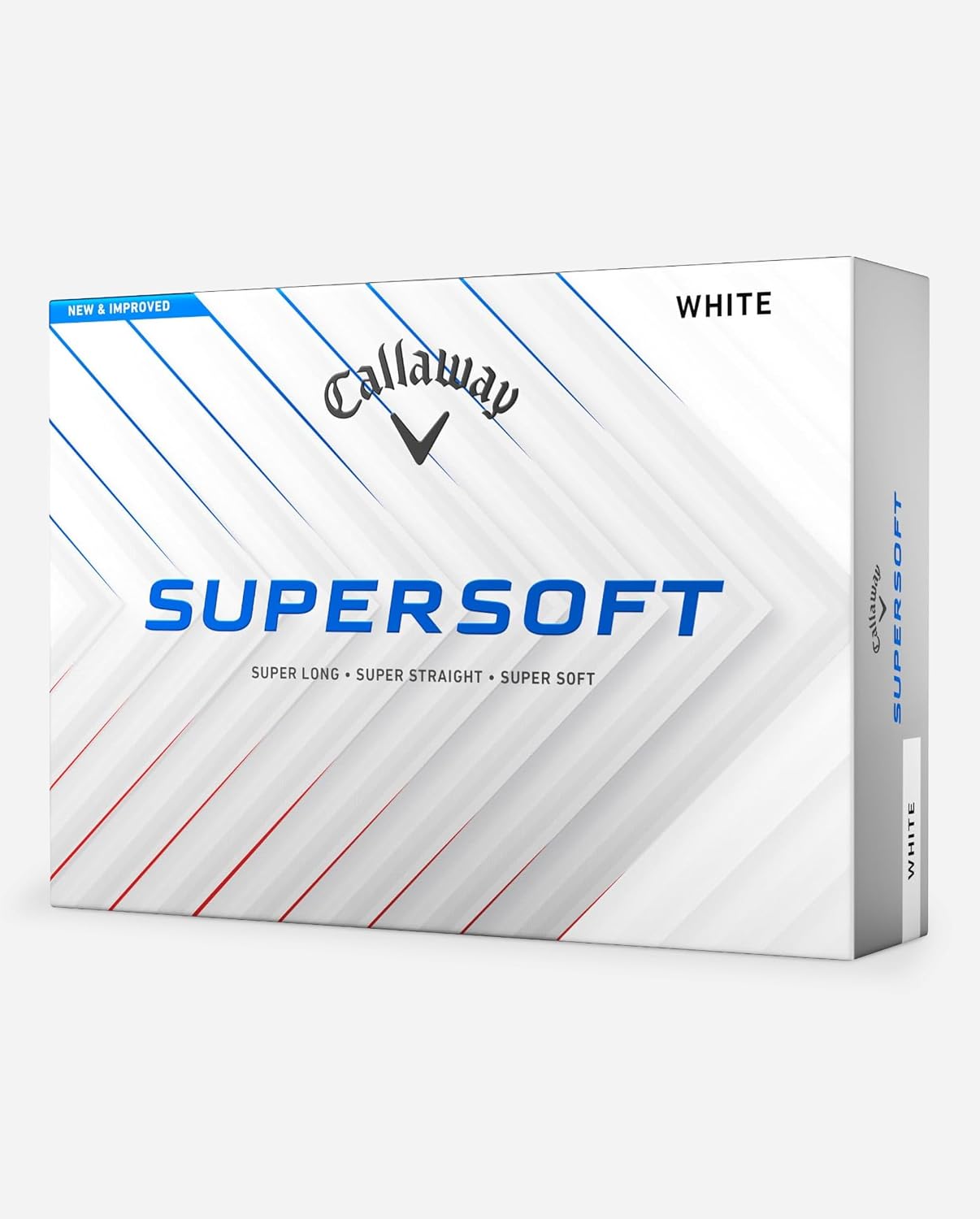
Yes, with an honest caveat. The Callaway Supersoft is a 2-piece hybrid-cover ball at $24.99 MSRP — genuinely soft feel, respectable distance for its price, and a color lineup no cheap-tier competitor matches. MyGolfSpy Ball Lab measured it at 44 compression, which is very-soft (though not the softest — Wilson Duo Soft measures 35). For a slow-to-moderate swing under 90 mph who wants a real Callaway ball at cheap-tier pricing, this is a legitimate pick.
The caveat: MGS’s 2026 Ball Lab audit graded the current-gen Supersoft a Quality Score of 74 (C — “Not Recommended”) for compression consistency — a 13.5-point spread across the sample, more than twice the database average. For casual play, most golfers won’t notice. For tournament rounds or players who obsess over predictable flight, the QC gap is real. Full breakdown below.
Who The Supersoft Is For (And Who It Isn’t)
The Callaway Supersoft fits you if:
- Your driver swing speed is 70-90 mph. The 44-compression core compresses cleanly at these speeds. Faster swings over-compress it and give up ball speed.
- Feel is your priority. Softer than Titleist TruFeel (70), softer than Srixon Soft Feel (60), only slightly firmer than Wilson Duo Soft (35).
- You want the Callaway brand at cheap-tier pricing. $25 vs Chrome Soft’s $45 — the Supersoft is the entry into the Callaway family with a real savings.
- You lose 2+ balls per round. At $2 per ball, cheap balls make sense for anyone whose game produces water balls and OB losses regularly.
- You want color options. White, yellow, red, orange, green, pink — all matte, all $25. Colored balls are legitimately easier to spot in rough.
- Your slice is a problem. Low-compression balls produce less sidespin, which tames curve.
The Supersoft is the wrong ball for you if:
- Your driver swing speed is 95+ mph. You’ll over-compress the core and lose meaningful ball speed. Look at TaylorMade Distance+ (77 compression), the Warbird, or step into a tour ball.
- You need urethane greenside spin. The hybrid ionomer cover produces limited wedge check. Kirkland Signature Performance+ ($17.50 effective) is a cheap urethane alternative.
- You play competitive golf and care about ball-to-ball consistency. The MGS 2026 C-grade for compression consistency (13.5-point spread) matters here. Titleist TruFeel or Bridgestone e6 Soft are more consistent per MGS at similar prices.
- You want the absolute softest feel on the market. Callaway’s “softest” claim doesn’t survive MGS’s gauge — Duo Soft (35) is measurably softer than Supersoft (44). Supersoft is very-soft, but not the softest.
Compression, Construction, and the MGS QC Finding
Callaway markets the Supersoft as “X-Soft” without publishing a specific number. Independent measurements have varied across generations — the ball has ranged between 37 and 47 compression on MyGolfSpy Ball Lab’s gauge over the years. The 2026 measurement came in at 44, which is genuinely very-soft. For context: Wilson Duo Soft measures 35, Bridgestone e6 Soft measures 44 (a tie), Srixon Soft Feel 60, Titleist TruFeel 70. The Supersoft delivers on the soft-feel promise; it’s just not the softest.
Most Supersoft reviews online skip this next part, but the 2026 MyGolfSpy Ball Lab audit gave the current-gen Supersoft a Quality Score of 74 (C grade), with a formal “Not Recommended” designation. Here’s what MGS measured:
| Metric | Result | Grade |
|---|---|---|
| Overall Quality Score | 74 / 100 | C — Not Recommended |
| Compression Consistency | 13.5-point spread (40.3-53.8) | C-minus |
| Compression Symmetry | 3.0 points (vs 1.9 database average) | Weakest metric |
| Diameter / Roundness | 0.0017-inch deviation, seam bias in 32/36 balls | B-minus |
| Good Ball Rate | 92% (33/36 passed) | Acceptable |
What that means practically: the 13.5-point compression spread is more than twice the MGS database average (9.7). Individual balls in your dozen may compress 8-10 points differently, which translates to different feel and slightly different ball speed at impact. The seam bias doesn’t affect tee shots but can produce inconsistent roll on longer putts where the ball rotates multiple times. The 92% good ball rate means roughly 1 in 12 balls is a lower-quality specimen — a real but manageable tax at $25.
Callaway contract-manufactures the Supersoft at Launch Technologies in Taiwan plus one dozen from Thailand — not a Callaway-owned facility. Compare to Titleist, which manufactures cheap-tier balls at Titleist-owned Ball Plant 2, and MGS’s data consistently shows above-average ionomer QC there. That ownership difference is the likely explanation for the QC gap.
Should this stop you buying? Depends how you play. Casual weekend rounds — no, the gap won’t affect your enjoyment or your score meaningfully. Tournament play or shot-by-shot optimization — consider the Titleist TruFeel or Bridgestone e6 Soft instead. Same price band, better QC per MGS.
| Construction | 2-piece: low-compression core, hybrid cover |
| Cover | Hybrid ionomer (Callaway proprietary blend) |
| Dimples | 332 hex-shape |
| MGS measured compression | 44 (2026 sample, C-grade consistency) |
| Colors | White, Yellow, Red, Orange, Green, Pink (matte, same price) |
| Alignment aid | Triple Track (three parallel lines) on select variants |
| USGA status | Conforming |
| MSRP / dozen | $24.99 (typical retail $23-27) |
Where the Supersoft Fits in Callaway’s Lineup
The old “Supersoft vs Chrome Soft” comparison shows up in a lot of reviews, and it’s misleading. They’re not competing balls — they’re different tiers of the Callaway lineup entirely:
| Supersoft | Supersoft Max | Chrome Soft | Chrome Tour | |
|---|---|---|---|---|
| Price / dozen | $25 | $27 | $45 | $55 |
| Compression | 44 | ~55 | ~70 | ~85 |
| Construction | 2-piece | 2-piece | 3-piece | 3-piece |
| Cover | Hybrid ionomer | Hybrid ionomer | Urethane | Urethane |
| Target driver speed | 70-90 mph | 85-100 mph | 85-105 mph | 95-110+ mph |
Supersoft is entry-tier ionomer; Chrome Soft is mid-tier urethane. Different categories entirely, priced differently, built for meaningfully different players. The correct comparisons for the Supersoft are Titleist TruFeel, Srixon Soft Feel, Bridgestone e6 Soft, and Wilson Duo Soft — all cheap-tier soft-feel balls in the same $22-30 band. Callaway introduced the Supersoft Max in 2024 for players who want the Supersoft feel signature at slightly faster swing speeds; at ~55 compression and $27 it’s a modest step firmer.
On-Course Performance and Stopping Power
- Off the tee: soft compression works to your advantage at moderate swings. Low sidespin keeps the ball flying straighter. Distance is respectable — not the longest in the price band (Noodle Long & Soft has an edge), but plenty for the target audience.
- Irons: high launch produces steep descent angles that help hold greens on approach. Golflink’s 2026 head-to-head test found the Supersoft outperformed the Srixon Soft Feel on 3 of 4 categories, with the largest gap on stopping power — the ball checks up more effectively than most cheap-tier competitors.
- Wedges: some greenside grab from the hybrid cover — noticeably more than a hard ionomer, but not urethane-level. Chip-and-run works well; flop shots roll out further than you’d want.
- Putting: soft off the face, muted impact sound. Preferences vary; some players love the quiet feedback, others want more auditory response.
- Wind: the high launch that helps on approaches also makes the ball more susceptible to wind. On breezy days a firmer lower-launching ball (Distance+, Warbird) can be more predictable.
- Durability: soft cover scuffs more easily than firm ionomer. Expect 1 round per ball for most golfers — normal at this price point.
Callaway leans harder into color variety than any competitor in the cheap-ball tier. Six matte colors at the same $25 price, plus a Triple Track alignment variant. Paint color has no measurable performance effect — the value is entirely visibility. If you lose 3+ balls per round, spending an extra 5 seconds locating your ball from further away in the rough is a real quality-of-life upgrade.
Pros and Cons
Pros
- Genuinely soft feel (MGS 44 compression)
- Real Callaway brand at cheap-tier price
- Widest color selection in the category
- Better stopping power than Srixon Soft Feel (Golflink 2026)
- Triple Track alignment available at same price
- Low sidespin helps straighten slice tendencies
- Widely available everywhere
Cons
- MGS 2026 Quality Score 74 — C grade, Not Recommended
- Not actually “the softest” — Duo Soft (35) is softer
- Limited greenside spin (no urethane check)
- Cover scuffs easily; ~1 round per ball
- Over-compresses above 95 mph driver speed
- Contract-manufactured (Taiwan/Thailand), not Callaway-owned
How the Supersoft Stacks Up (and Where to Buy)
MSRP is $24.99/dozen; real-world retail runs $23-27 at Amazon, PGA Tour Superstore, Golf Galaxy, Dick’s, Walmart, and callawaygolf.com. Three cheap-tier soft-feel balls compete directly:
Titleist TruFeel — better QC, similar price
Compression 70 measured — meaningfully firmer than Supersoft (44), so different feel signature. Titleist’s manufacturing is above-average for ionomer per MGS. TruFeel has better iron carry (MGS 3rd in the 2026 field at 85 mph). If QC and iron performance matter more than the softest possible feel, TruFeel is the better pick at $29.99.
Srixon Soft Feel — cheaper direct competitor
Compression 60 measured — firmer than Supersoft, softer than TruFeel. $22/dozen (cheaper than Supersoft). Golflink’s 2026 test found Supersoft won 3 of 4 categories in a head-to-head, with the largest gap on stopping power. Pick Soft Feel to save $3; pick Supersoft if you want the softer feel and better greenside check.
Wilson Duo Soft — actually the softest 2-piece
Compression 35 measured — genuinely the softest 2-piece ball on the market. $25/dozen (same price as Supersoft). If softest feel is your priority, Duo Soft actually delivers on that promise. Wilson doesn’t have Callaway’s brand halo or color selection, but the ball itself is legit.
Frequently Asked Questions
Is the Callaway Supersoft any good?
Yes for slow-to-moderate swings (under 90 mph driver) who want a soft-feeling ball at cheap-tier pricing, with the caveat that MGS’s 2026 audit graded the current gen a C for compression consistency. Casual play, not an issue. Tournament play, look at TruFeel or Bridgestone e6 Soft instead.
What is the compression of the Callaway Supersoft?
MyGolfSpy Ball Lab measured the 2026 Supersoft at 44. Callaway markets it as “X-Soft” without a published number; measurements have ranged 37-47 across generations. Very-soft, but Wilson Duo Soft (35) is softer.
What swing speed is the Supersoft designed for?
Driver swing speeds of 70-90 mph. Above 95 the soft core over-compresses and gives up ball speed — look at Supersoft Max ($27) or a firmer ball. Below 70, the Wilson Duo Soft (35) may fit slightly better.
Callaway Supersoft vs Titleist TruFeel — which is better?
Different balls for different priorities. Supersoft is softer (44 vs 70), better stopping power, more colors, cheaper. TruFeel is firmer, better iron carry (MGS 3rd at 85 mph), and above-average QC. Feel and color choice → Supersoft. Iron performance and consistency → TruFeel.
Supersoft vs Chrome Soft — which is better?
Different categories, not competing balls. Supersoft is 2-piece ionomer at $25 (cheap tier). Chrome Soft is 3-piece urethane at $45 (mid tier). Chrome Soft is better if you can afford it and have a short game that benefits from urethane. Supersoft is better if $20 savings matters or your wedge contact isn’t there yet.
How durable is the Callaway Supersoft?
Moderate. The soft hybrid cover scuffs more easily than firm ionomer — expect 1 round per ball for most golfers. Cart-path grinds, sand walls, and tree contact leave marks, but scuffing doesn’t affect flight until it’s severe. Normal at this price.
Final Verdict
The Callaway Supersoft is a legitimately good ball for a specific reader: 70-90 mph driver speed, soft-feel preference, wants the Callaway brand at cheap-tier pricing, and either doesn’t care about tournament-grade QC or plays casually enough that the MGS C-grade doesn’t affect the round. For that reader, at $25 with 6+ color options and better stopping power than Srixon Soft Feel at $22, the Supersoft earns its place.
The caveats are honest. It’s not actually “the softest golf ball on the planet” — that title belongs to the Wilson Duo Soft at the same $25. Compression consistency is a real weakness per MGS’s 2026 audit. Faster swings over-compress the core. Greenside spin is limited compared to any urethane ball. If soft feel is your top priority and you’re inside the swing-speed window, buy it in whatever color you like and don’t overthink it. If you’re on the edge of the fitting window or prioritize consistency for competitive play, the Titleist TruFeel or Bridgestone e6 Soft are worth considering at similar prices.
Related reading: Best Cheap Golf Balls 2026 | Titleist TruFeel Review | Best Golf Balls for Slow Swing Speeds