
Last updated: September 5, 2026
⛳️ Our experts spend hours testing golf balls on the launch monitor, on-course, and reading every independent lab report we can find, before recommending anything. When you make a purchase through one of our links, we may earn a small affiliate commission, at no cost to you. Find out more about how we test products.
Quick Verdict: Is the Titleist TruFeel Worth It?
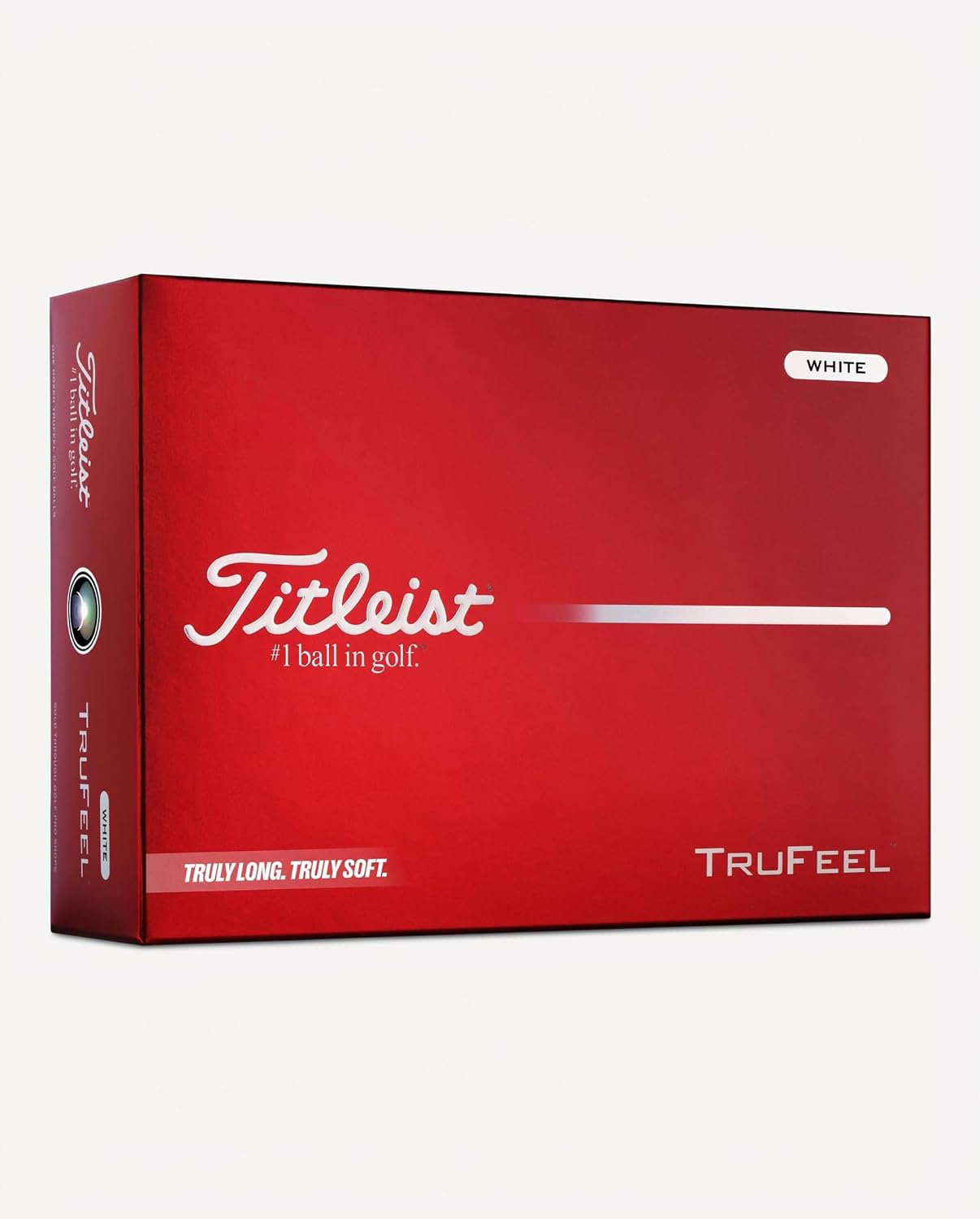
Yes, for the right golfer. The Titleist TruFeel is the cheapest ball in Titleist’s lineup — $29.99 MSRP, retail around $25-30 — and it delivers real Titleist engineering at cheap-tier pricing. It’s a 2-piece ionomer ball, so you’re not getting Pro V1 greenside spin, but for a moderate swing speed (roughly 70-95 mph driver) who wants a Titleist ball without paying $55 for it, this is the answer.
On my GC3 launch monitor the TruFeel produced some of the lowest driver spin I’ve measured — around 1,500 rpm average. That’s remarkably low and translates to straighter ball flight. Ball speed came in about 5 mph lower than premium urethane balls, but low spin plus a naturally high trajectory produced comparable total distance to the Callaway Supersoft I tested it against. Full breakdown below.
Who The TruFeel Is For (And Who It Isn’t)
The Titleist TruFeel fits you if:
- Your driver swing speed is 70-95 mph. The 70-compression core (measured by MyGolfSpy) compresses cleanly at those speeds. Above 95 you over-compress and give up ball speed.
- You want a Titleist ball but not a Pro V1 budget. $29.99 vs $55 — you save $25 a dozen and get a well-made ionomer ball built at Titleist’s Ball Plant 2.
- Feel matters. The 3.0 TruFlex cover produces a genuinely soft impact off wedges and putter, softer than the average ionomer ball at this price.
- Your typical miss off the tee is a slice or hook. Low driver spin (~1,500 rpm in my test) reduces sidespin, which is the physics behind curve.
- You want iron performance better than a Supersoft or Duo Soft. MGS’s 2026 Ball Test ranked TruFeel 3rd in iron carry at 85 mph and gave it the highest peak height in the field — real approach-shot stopping power softer cheap balls don’t have.
The TruFeel is the wrong ball for you if:
- Your driver swing speed is 95+ mph. Look at Titleist Velocity (measured 90 compression) or step into urethane (Tour Soft, Pro V1). At 100 mph you’ll leave real ball speed on the table.
- You need urethane greenside spin. The ionomer cover produces meaningfully less wedge check. Titleist’s own Tour Soft ($40, 88 compression) is the mid-tier bridge; Kirkland Signature Performance+ ($17.50 effective) is the cheap urethane alternative.
- You want the softest feel at this price. The Callaway Supersoft (measured 44) and Wilson Duo Soft (measured 35) feel meaningfully softer. TruFeel is soft-mid, not ultra-soft.
- You want the cheapest Titleist option. This already is the cheapest Titleist. If price alone is the priority, Kirkland V3 or Vice Drive is $12-17.
Where the TruFeel Fits in Titleist’s Lineup
Titleist calls their non-urethane balls the “performance lineup.” Three distinct balls, three distinct fits — not price points of the same ball.
| Velocity | TruFeel | Tour Soft | |
|---|---|---|---|
| MSRP | $32 | $29.99 | $40 |
| MGS compression | 90 | 70 | 88 |
| Construction | 2-piece ionomer | 2-piece ionomer | 2-piece ionomer |
| Priority | Distance | Soft feel | Urethane-adjacent |
| Driver speed | 90+ mph | 70-95 mph | 85-105 mph |
| Greenside | Low | Low-mid (best of the three) | Mid (closest to urethane) |
The interesting one is Tour Soft. MGS’s 2026 test called it the most complete ionomer ball on the market — behaves like a 90-compression urethane ball everywhere except greenside. If you can stretch $10 and swing north of 85 mph, that upgrade is meaningful. TruFeel is the correct pick if the budget is tight or your swing is at the slower end of the band.
Compression, Construction, and Specs
Titleist doesn’t publicly disclose the TruFeel’s compression, and their marketing consistently uses “ultra-soft” language that suggests something in the 40-50 range. Golfers looking at the TruFeel next to a Callaway Supersoft or Wilson Duo Soft reasonably expect similar softness. That’s not the reality.
MyGolfSpy’s 2026 Ball Test measured the current TruFeel at 70 compression on their gauge — the industry’s cross-brand comparable measurement. On the same gauge: Wilson Duo Soft 35 (properly ultra-soft), Callaway Supersoft 44, Titleist Tour Soft 88, Titleist Pro V1 92.5, Titleist Velocity 90. The TruFeel is soft-mid, not ultra-soft. It feels softer than 70 suggests because the 3.0 TruFlex cover softens impact regardless of core compression — that’s where the reviewer consensus of “genuinely soft feel” comes from.
Practical upside: at 70 compression the TruFeel doesn’t over-compress the way a 35-compression ball does at the upper end of its range. If your driver speed is 90-95 mph you’ll get more ball speed than a Supersoft, because you’re not squishing the core past its usable range.
| Manufacturer | Titleist (Ball Plant 2, Massachusetts — Titleist-owned) |
| Construction | 2-piece: large low-compression TruTouch core, 3.0 TruFlex cover |
| Dimples | 376 spherically-tiled aerodynamic dimples |
| Core diameter | 1.600 inches (larger than the ionomer average) |
| MGS measured compression | 70 (2026 Ball Test) |
| USGA status | Conforming |
| Colors | White, Optic Yellow, Matte Red |
| Alignment aid | Side-stamp AIM design (customizable via Titleist.com) |
| MSRP / dozen | $29.99 (typical retail $25-30) |
Two things separate TruFeel from most cheap balls. First, it’s built at Titleist’s own Ball Plant 2 in Massachusetts, not a third-party overseas facility — MGS’s Ball Lab research consistently shows Titleist’s ionomer balls grade above-average for consistency because Titleist owns the manufacturing end-to-end. Second, the TruTouch core is genuinely large (1.600 inches), giving more energy transfer at impact and a larger sweet spot. Real construction features, not marketing.
My GC3 Simulator Test: TruFeel vs Callaway Supersoft
I’ve hit thousands of balls in my simulator on a Foresight GC3 launch monitor. When the TruFeel came up for review I put it head-to-head against the Callaway Supersoft — the closest competitor and the ball most reviewers name as TruFeel’s alternative. What the numbers said:
- Driver spin (TruFeel): around 1,500 rpm average. Anything under 2,000 rpm is very good for a moderate swing, and TruFeel came in well below that. Low driver spin is the physics behind straight ball flight.
- Driver spin (Supersoft): meaningfully higher than TruFeel. Softer balls spin more off the driver at moderate swings. Both are low-spin category, but TruFeel came in noticeably lower.
- Ball speed (TruFeel): about 5 mph slower than premium urethane balls through the same swing. Ionomer-tier price of admission.
- Ball speed (Supersoft): slightly faster than TruFeel. The Supersoft beat it here.
- Trajectory (TruFeel): higher than the Supersoft, matching MGS’s finding that TruFeel produced the highest peak height in the entire 2026 field.
- Total distance (TruFeel): slightly longer than the Supersoft despite the ball-speed deficit. Higher launch and lower spin combined for more airtime and more carry. Surprised me — I expected ball speed to matter more, but the trajectory offset closed the gap.
Followed it up with a full on-course round using the TruFeel: straight drives (low spin shows up as controllable flight), respectable irons (the high peak held greens on approach), weak greenside (as advertised — chip shots ran out further than a urethane ball).
On-Course Performance
- Off the tee: straight ball flight is the headline. If you slice or hook, low spin reduces the curve without eliminating it. Distance is competitive with any 2-piece cheap ball at moderate swing.
- Mid and long irons: this is where TruFeel outperforms most cheap balls. MGS’s 2026 test found TruFeel produced the highest peak height in the entire field at their 7-iron condition with one of the steepest landing angles, plus measurably higher iron spin than the softer competitors. High launch + steep descent + moderate spin stops the ball on firm greens. Softer 2-piece balls (Supersoft, Duo Soft) fly lower and release across the green.
- Short irons and wedges: feel is genuinely good off the face; the TruFlex cover produces a soft, muted impact. Distance control is dependable.
- Greenside: the tradeoff. TruFeel produces roughly 30-40% less wedge spin than a urethane tour ball on clean lies — the 2-piece ionomer ceiling, not a TruFeel-specific weakness. Chip-and-run and bump-and-run work fine; flop shots roll out. Silver lining: MGS found TruFeel has the highest greenside spin of Titleist’s three ionomer balls, so within the ionomer category it’s the best short-game option.
- Putting: soft off the putter face, muted click, good tactile feedback for distance control. This is where “TruFeel” earns the name.
- Durability: the TruFlex cover holds up well through a round. Titleist-owned manufacturing shows in the consistency.
Pros and Cons
Pros
- Real Titleist engineering at cheap-tier price ($29.99)
- Very low driver spin (~1,500 rpm) helps straighten slices and hooks
- Highest peak height and steep landing angle — real approach-shot stopping power
- Genuinely soft feel off wedges and putter (3.0 TruFlex cover)
- Manufactured at Titleist’s own Ball Plant 2 — above-average ionomer QC
- 3 color options (white, optic yellow, matte red)
- Available at every golf retailer
Cons
- “Ultra-soft” marketing but MGS measured 70 — softer balls exist
- Ball speed ~5 mph lower than premium urethane at the same swing
- Limited greenside spin, especially on flop shots
- Not for swing speeds above 95 mph
- Priced at the top of the cheap tier — Kirkland or Vice Drive is much cheaper
- Not the softest cheap option (Duo Soft and Supersoft feel softer)
How the TruFeel Stacks Up (and Where to Buy)
MSRP is $29.99/dozen; retail runs $25-30 at Amazon, PGA Tour Superstore, Golf Galaxy, Dick’s, and titleist.com. Three cheap-tier soft-feel balls compete directly:
Callaway Supersoft — softer feel, similar price
Compression 44 measured — noticeably softer feel than TruFeel. Slightly higher greenside spin. $25/dozen. Less iron-carry authority than TruFeel per MGS. Pick this if feel is your priority and you don’t need the iron-play advantage.
Srixon Soft Feel — best value slow-swing option
Compression 60 measured — softer than TruFeel, firmer than Supersoft. $22/dozen (cheaper than both). Straightforward 2-piece ionomer with no gimmicks. Pick this for the best mix of value and feel at slow-to-moderate swings.
Wilson Duo Soft — softest 2-piece on the market
Compression 35 measured — genuinely the softest 2-piece you can buy. $25/dozen. Wilson doesn’t have Titleist’s brand halo, but the ball is legit. Pick this if you love feeling the ball compress at slow swings.
Frequently Asked Questions
Are Titleist TruFeel golf balls any good?
Yes for moderate swing speeds under 95 mph and mid-to-high handicappers who want Titleist engineering at cheap-tier pricing. Legitimate soft feel, very low driver spin (~1,500 rpm on my GC3), and 3rd-place iron carry in MGS’s 2026 test at 85 mph. The catch is limited greenside spin, but among cheap ionomer balls TruFeel has the best iron play in the category.
What is the compression of the Titleist TruFeel?
MyGolfSpy’s 2026 Ball Test measured it at 70 on their gauge. Titleist doesn’t publish a number and markets the ball as “ultra-soft,” which is misleading — Callaway Supersoft (44) and Wilson Duo Soft (35) are meaningfully softer. The 3.0 TruFlex cover softens impact feel beyond what the core compression alone suggests.
What swing speed is the TruFeel designed for?
Driver swing speeds of 70-95 mph. Above 95 the 70-compression core over-compresses and gives up ball speed — look at Velocity ($32, 90 compression) or step to urethane. Below 70 you may fit slightly better into a Duo Soft or Supersoft, but TruFeel is still playable.
TruFeel vs Callaway Supersoft — which is better?
Different balls for different priorities. Supersoft is softer (44 vs 70) and slightly cheaper ($25 vs $29.99). TruFeel has real advantages in driver spin (~1,500 rpm vs Supersoft’s higher number), iron carry (MGS 3rd at 85 mph), and peak height (highest in the 2026 field). Pick Supersoft for soft feel. Pick TruFeel for approach-shot stopping power.
Where does the TruFeel fit in Titleist’s lineup?
Titleist’s performance line has three ionomer tiers: Velocity (90 comp, distance-first), TruFeel (70 comp, soft feel), Tour Soft (88 comp, urethane-adjacent). Above them sit the urethane tour balls (Pro V1, Pro V1x, AVX, Left Dash at $55). TruFeel is the entry — the cheapest way to play a Titleist.
Can I use the TruFeel in tournament play?
Yes — USGA-conforming and legal for any format. Titleist’s manufacturing consistency is above-average for ionomer per MGS, so ball-to-ball variance is less of a concern than with cheaper ionomer options. That said, at competitive levels where every stroke counts, the greenside gap versus urethane will show up in scoring — move up to Tour Soft or Pro V1 for tournaments.
Final Verdict
The Titleist TruFeel is the correct default for a specific golfer: moderate swing speed (70-95 mph driver), soft-feel preference, mid-to-high handicap, wanting the Titleist brand and engineering at cheap-tier pricing. At $29.99 it delivers real Titleist QC, very low driver spin, the highest peak height in MGS’s 2026 field for approach-shot stopping power, and a genuinely soft feel off the putter and wedges.
The name is misleading (MGS measured 70, not the “ultra-soft” the marketing implies) and greenside spin is limited compared to urethane. Real caveats, not deal-breakers — every 2-piece ionomer at this price has the same greenside ceiling. My GC3 data backs up the reviewer consensus: TruFeel flies straight, holds greens meaningfully better than a Supersoft or Duo Soft, and feels great where it counts. If you’re outside the target audience — much faster swing or a short game that depends on wedge check — spend the extra $10-25 for Tour Soft or Pro V1.
Related reading: Best Cheap Golf Balls 2026 | Callaway Supersoft Review | Best Golf Balls for High Handicappers