
Last updated: September 6, 2026
⛳️ We test golf balls on a Foresight GC3 launch monitor and on-course before recommending anything. Purchases through our links may earn us a small affiliate commission at no cost to you. See our affiliate disclosure.
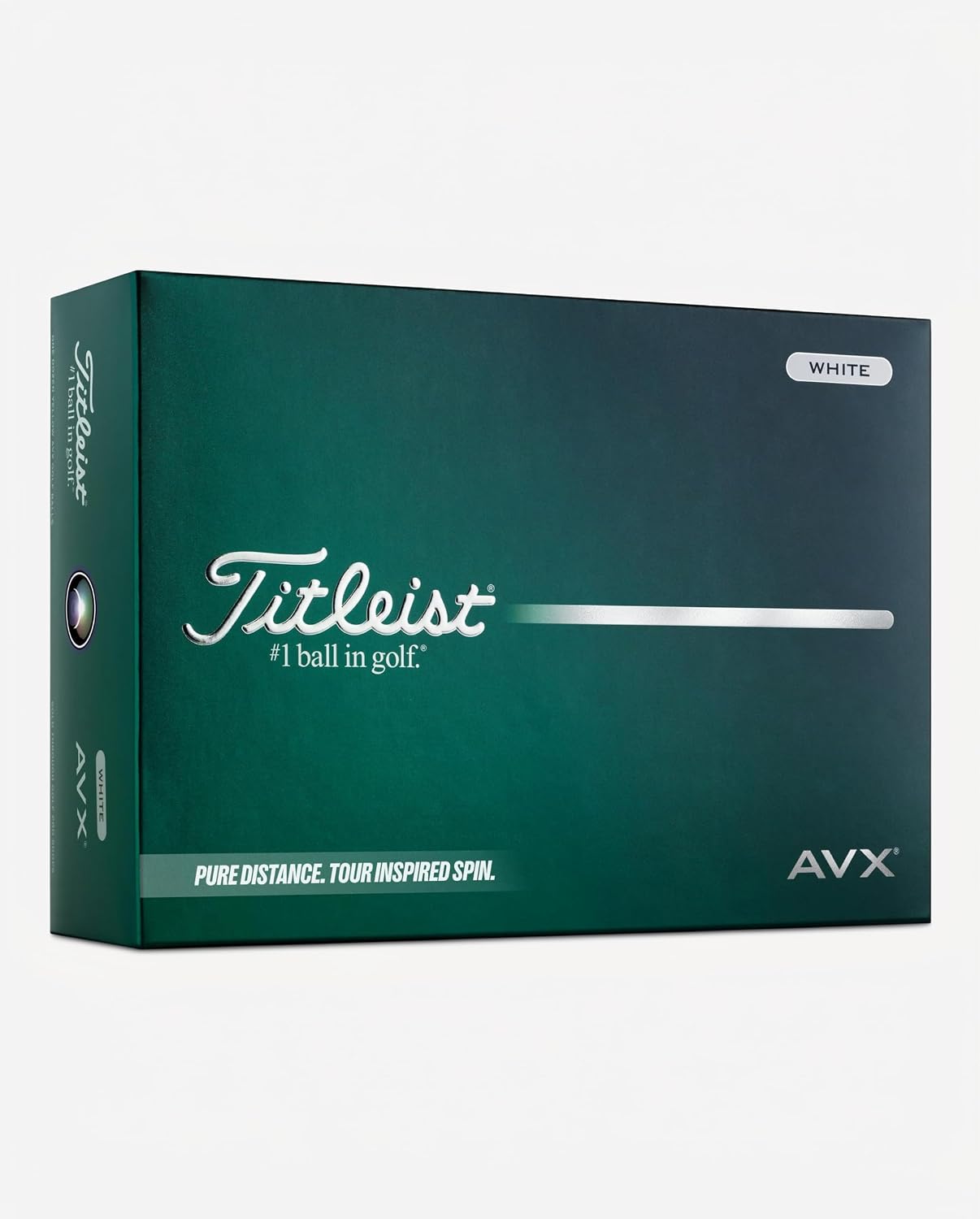
Quick Verdict: Is the Titleist AVX Worth It?
Yes, for a specific golfer. If you swing the driver 85-110 mph and want a Titleist urethane ball with lower flight, lower long-game spin, and softer feel than Pro V1 — for $8 less per dozen — the AVX fits. Titleist internally calls it their “Fountain of Youth” ball because the flatter trajectory and low spin help golfers recover distance they’ve lost to swing-speed decline.
The 5th-generation 2026 model (announced January 14, 2026, at retail January 21) reworks the core for more speed, drops long-game spin, and thickens the urethane cover to improve greenside spin. MSRP holds at $49.99 — unchanged from the 2024 model, and now $8 below the Pro V1 family at $57.99. Below is the full breakdown — including the “big distance with irons” finding from my GC3 test that surprised me the first time I saw it.
Who The AVX Is For (And Who It Isn’t)
Ball fitting is about swing speed and short-game contact, not handicap. Here’s how the AVX maps to actual golfers.
The AVX is a good fit if:
- Your driver swing speed is 85-110 mph and you want a lower, penetrating ball flight that resists wind and produces more rollout on landing.
- You’ve lost clubhead speed over time and want to recover distance without a swing overhaul. This is the Fountain of Youth pitch — lower flight and lower spin let a slower swing convert what ball speed remains into more total distance.
- You over-spin Pro V1 or Pro V1x off the tee. If your driver launches too high or spins above 3,000 rpm, AVX’s lower-spinning long game will straighten your ball flight.
- You want softer feel than Pro V1 delivers. AVX at 78 compression is meaningfully softer than Pro V1 or Pro V1x at 92.
The AVX is NOT for you if:
- You love your current Pro V1 or Pro V1x. If your ball already produces the trajectory, spin, and feel you want, AVX will change those variables in ways you didn’t ask for.
- You want a high-launch ball. AVX’s low flight is intentional. It’s the wrong feature if you already fight a low ball flight.
- You want the softest possible ball. AVX at compression 78 is only soft relative to other urethane tour balls. Compared to Wilson Duo Soft (35) or Callaway Supersoft (44), it will feel firm.
What’s New in the 2026 AVX
The 2026 AVX is the 5th generation since the original 2018 launch. Every layer changed. Titleist reworked the core for more ball speed, reformulated the casing layer for lower long-game spin, thickened and softened the urethane cover to improve greenside spin, and rolled out a new aerodynamic package for more penetrating flight. MSRP stays at $49.99 per dozen — the same as the 2024 generation — while the Pro V1 family sits at $57.99, so the AVX-vs-Pro V1 gap is now $8.
The greenside cover change matters most on paper. Historically, AVX’s biggest complaint versus Pro V1 was less wedge spin on clean-strike short shots. The 2026 update thickens and softens the urethane so it pinches harder against the firmer casing at impact, generating more surface friction. Independent 2026 reviews split on whether the change is meaningful in the hand: National Club Golfer came away positive, while Today’s Golfer gave the short game 3.5/5 and listed “greenside spin hasn’t notably improved” as a con. On my own simulator, clean-strike 56° wedges checked up better than the previous-gen AVX — but I don’t have published wedge RPM data to quantify by how much. Manage expectations: AVX is still a low-spin ball. If you need Pro V1’s short-game bite, buy Pro V1.
Where the AVX Fits in Titleist’s Lineup
AVX is one of four urethane balls in Titleist’s premium tier. Each targets a different combination of flight, spin, and feel.
| Ball | Compression | Flight | Long-game spin | Best for |
|---|---|---|---|---|
| AVX | 78 | Lower | Lowest of family | 85-110 mph, over-spinners, softer feel |
| Pro V1 | 92 | Mid | Mid | 95-110 mph, balanced tour performance |
| Pro V1x | 92 | Higher | Higher (all clubs) | 95-115 mph, high-launch tour spin |
| Pro V1x Left Dash | 102 | Higher | Lowest driver spin, tour irons | 100+ mph, low-spin specialist |
Construction, Specs, and the Ball Plant 2 Story
Three-piece construction: reworked speed core, reformulated casing layer, injection-molded urethane cover with 346 quadrilateral dipyramid catenary dimples. Compression 78 (MyGolfSpy measured “in the high 70s”). Available in white and high-optic yellow.
Here’s the technical detail most reviews skip: AVX’s urethane cover is injection-molded, not cast the traditional way. Pro V1, Pro V1x, and Left Dash all use cast urethane produced at Titleist Ball Plant 3. AVX uses an injection-molded process at Ball Plant 2, originally developed for the (now-discontinued) Tour Speed. The injection-molded process is more cost-efficient — part of why AVX is cheaper than Pro V1. It historically produced slightly less greenside spin than cast urethane, which is the specific gap the 2026 cover reformulation targets.
Compression 78 gives AVX a wider fit window than the firmer Pro V1 family. Moderate swing speeds (85-95 mph) compress it cleanly. Faster swings (100-110 mph) still work — AVX just becomes slightly less responsive than Pro V1x or Left Dash at those speeds.
My GC3 Simulator Test: AVX vs Pro V1
I ran the 2026 AVX head-to-head against the Pro V1 on my Foresight GC3 launch monitor — the natural comparison for anyone weighing whether to try AVX or stay with Titleist’s flagship. Highlights:
- Driver ball speed: AVX ran 1-2 mph slower than Pro V1 at my swing speed. The 2026 core update closed the gap versus the previous generation, but Pro V1 still edges it.
- Driver spin: meaningfully lower on AVX. The “low-spin” positioning is real. My ballooning-drive tendency muted noticeably.
- Ball flight: lower, penetrating trajectory versus Pro V1’s higher window. Total distance came out comparable — the flatter flight added rollout that offset the small ball-speed deficit.
- Irons — the big finding: AVX produced 2-3 yards more carry per iron than Pro V1, consistently across the bag. That’s the “big distance with irons” observation from my original review, still true in the 2026 gen. Low iron spin plus a firm-feeling casing produces more efficient iron flight at moderate swing speeds.
- Wedges (56°, half swing): Pro V1 still had a clear edge. The 2026 AVX checked up better than the previous-gen AVX on clean-strike chips — enough to notice — but it isn’t a substitute for Pro V1 if you need maximum short-game bite.
- Feel: softer than Pro V1 throughout the bag. The 78 compression plus softer cover comes through clearly, especially on iron strikes and putts.
The iron finding is what makes AVX interesting for me. If your driver is dialed in but your 7-iron feels short, AVX is worth testing for that specific reason — not for driver distance, where Pro V1 wins by a hair.
Pros and Cons
Pros
- Real Titleist urethane at $8 less per dozen than the Pro V1 family
- Softer feel than any Pro V1 variant (78 vs 92 compression)
- Lower penetrating flight resists wind, adds rollout
- Meaningful iron-carry advantage at moderate swing speeds
- 2026 update targets a longstanding weakness — greenside spin — with a thicker, softer cover
- Wider fit window (85-110 mph) than the firmer Pro V1 family
Cons
- 1-2 mph slower ball speed than Pro V1 off the driver
- Slightly less greenside spin than Pro V1 on clean wedges
- Low flight profile is polarizing — some players hate it
- Wrong ball for high-launch specialists
- Not “soft” outside urethane tier — 78 still feels firm vs ionomer softies
Price and Where to Buy
Titleist MSRP is $49.99 per dozen for the 2026 model — the same MSRP AVX has held since the 2024 generation, and now $8 below the Pro V1 family at $57.99. Real-world retail runs $44-50. Available at Amazon, PGA Tour Superstore, Golf Galaxy, Dick’s, and titleist.com. Some retailers still have 2024 AVX stock at $40-45 discounts — if you specifically want the improved greenside cover and the reworked core, verify production year on the box.
How the AVX Stacks Up Against 3 Competitors
Three mid-tier urethane balls that overlap AVX’s audience and price band:
Callaway Chrome Soft — closest cross-brand competitor
Compression 77, roughly matching AVX. Higher flight by design — Callaway aerodynamics favor launch over penetration. Priced similar to AVX at $45-50. Pick Chrome Soft for higher launch and Callaway’s overall feel signature. Pick AVX for lower flight and Titleist’s quality control.
TaylorMade Tour Response — softer, cheaper
Compression 71 measured — softer than AVX’s 78. Cast urethane cover, $39.99 MSRP ($10 cheaper). Pick Tour Response for softer feel and better value. Pick AVX for lower flight and lower long-game spin.
Vice Pro — DTC alternative at value price
Direct-to-consumer 3-piece cast urethane at $27-34 per dozen — substantially cheaper. Similar mid-tier soft-urethane fit on paper. Pick Vice Pro if you’re willing to order online and skip retail availability. Pick AVX for the Titleist brand halo and the specific low-flight profile.
Related BTG guides: our Pro V1x Left Dash review covers the low-spin specialist sibling, our mid-handicap ball guide ranks AVX among $30-50 options, and our senior golf ball guide features AVX in the Fountain of Youth context.
Frequently Asked Questions
Is the Titleist AVX any good?
Yes for a specific fit — 85-110 mph driver swing speeds who want lower flight, lower long-game spin, and softer feel than Pro V1 offers. The 2026 update targets greenside spin with a thicker, softer cover, though independent reviewers disagree on how much it moved the needle. Price holds at $49.99, $8 below the Pro V1 family.
What is the compression of the Titleist AVX?
Compression 78 catalog. Softer than any Pro V1 variant (Pro V1 and Pro V1x measure 92, Left Dash ~102). In the broader market, 78 is still soft-for-urethane rather than genuinely soft — ionomer balls like Wilson Duo Soft (35) or Callaway Supersoft (44) feel much softer.
What swing speed is the AVX designed for?
Driver swing speeds 85-110 mph, sweet spot 90-100 mph. Below 85 mph you can still play AVX but a softer ball may fit better; above 110 mph a firmer Pro V1x or Left Dash will produce more ball speed.
Titleist AVX vs Pro V1 — which is better?
Depends on your swing. Pro V1 is firmer, flies higher, spins more, and still produces more greenside spin. AVX is softer, flies lower, spins less, and — with the 2026 cover reformulation — narrows the greenside gap, though testers disagree on how much. Also $8 cheaper per dozen. Pick Pro V1 if you love your current setup or need max short-game spin; pick AVX if you over-spin the driver, want lower flight, or want softer feel.
What’s new in the 2026 AVX?
Fifth generation since 2018. Announced January 14, 2026, at retail January 21. Reworked core, reformulated casing, thicker and softer urethane cover, new 346-dimple aerodynamic package. MSRP stays at $49.99, unchanged from 2024. The cover reformulation targets greenside spin — independent reviewers came away split on whether the improvement is meaningful in play.
Does AVX have the same urethane cover as Pro V1?
Both are urethane, but different processes. Pro V1, Pro V1x, and Left Dash use cast urethane at Ball Plant 3. AVX uses injection-molded urethane at Ball Plant 2 — a more cost-efficient process originally developed for the discontinued Tour Speed. That’s part of why AVX is $8 cheaper per dozen. The 2026 cover reformulation targets the greenside-spin gap injection-molded urethane has historically had versus cast, though independent testing suggests the gap has narrowed rather than disappeared.
Final Verdict
The 2026 Titleist AVX answers a specific question: how do I play Titleist urethane at a lower price with softer feel and lower flight? For $49.99 — $8 below the Pro V1 family — you get real Titleist quality control, softer feel than any Pro V1, meaningful iron-distance gains at moderate swing speeds, and a greenside package that finally starts to close the historical gap with Pro V1 without fully catching it.
AVX isn’t a Pro V1 killer. Pro V1 still produces slightly more ball speed, slightly more greenside spin, and higher trajectory. If you love your Pro V1, don’t switch. But if your driver over-spins, your irons feel short, or you want softer feel in a Titleist wrapper at $8 less per dozen — the AVX earns the test.