Best Golf Balls for Seniors 2026: 10 Tested Picks by Swing Speed

Last updated: September 4, 2026

⛳️ Our experts spend hours testing golf balls on the launch monitor, on-course, and reading every independent lab report we can find, before recommending anything. When you make a purchase through one of our links, we may earn a small affiliate commission, at no cost to you. Find out more about how we test products.

Quick Verdict: Best Golf Ball for a Senior Golfer

The single most important thing about fitting a senior golfer for a ball: age isn’t the fitting variable, swing speed is. A 68-year-old who kept his speed at 105 mph doesn’t need the same ball as a 78-year-old who’s dropped to 78 mph. The picks below are organized by swing speed band, not age band. If you don’t know your current driver swing speed, get it measured — a launch monitor at any pro shop takes 3 minutes. Or use the swing speed calculator to estimate from your driver distance.

  • Best Overall for Slow Swing (Under 85 mph): Callaway Supersoft — 50 compression, hybrid cover, softest well-rounded ball on this list
  • Best Value: Kirkland Signature Performance+ — real 3-piece urethane at $25 per dozen
  • Softest Feel: Wilson Duo Soft — 37 compression, marketed as softest ball on market
  • Best High-Launch: Bridgestone e6 Soft — dimple pattern engineered for airborne carry at slower speeds
  • Best Trusted Brand: Titleist TruFeel — Titleist quality at 60 compression, $30
  • Best Premium Soft: Bridgestone Tour B RXS — softest urethane premium ball, real greenside grab
  • Best for 100+ mph Senior: Titleist Pro V1x Left Dash — for the senior who kept every mph of clubhead speed

The honest truth: the “senior golf ball” category is mostly marketing. A well-fit slow-swing ball works whether you’re 55 or 85. What matters is matching compression to your current swing speed and cover material to your short game contact quality.

Age Isn’t the Fitting Variable — Swing Speed Is

Every “senior golf balls” roundup in the top 10 starts with the same implicit assumption: senior = slow swing. That’s mostly true across the population, but it’s wrong often enough to matter for ball fitting. The reality:

  • Some seniors kept their speed. A 65-year-old with a lifetime of golf, decent fitness, and a Stack System routine can absolutely still swing 100+ mph. Match his ball to his speed, not his age.
  • Some 45-year-olds lost speed early to a back injury or reduced flexibility. If your driver carry dropped from 260 to 200 yards over the last five years, you need a slow-swing ball regardless of what your birth certificate says.
  • Age-related changes to hand strength or arthritis are real reasons to prefer a softer feel — but that’s a preference lever, not a fitting lever. It affects which ball you enjoy playing, not which one performs best.

The rest of this article is organized by driver swing speed band. Find your band, use the corresponding picks. Below 85 mph, low-compression balls are the correct fit. 85-95 mph, mid-compression. 95+ mph — you’re not the target audience for most “senior” balls, but Titleist AVX and Pro V1x Left Dash exist for a reason.

What Makes a Ball Right for a Slow-Swing Senior

The three ball attributes that actually matter for a senior golfer with a slower swing:

  1. Low compression. Under 60 for most slow swings. A softer core compresses more efficiently at lower clubhead speeds, which gives you a feel-friendly impact and consistent ball flight. This is not a distance-gain lever — the ball speed difference between a “60” and a “90” compression ball at 80 mph swing speed is under 1 mph. Compression is about feel.
  2. High launch. Slower swings need help getting the ball airborne. Balls designed for higher launch (Bridgestone e6 Soft, Titleist TruFeel, Callaway Supersoft) have dimple patterns and mantle constructions tuned for lift at moderate speeds. This IS a scoring lever — 8 more yards of carry from higher launch is real.
  3. Cover material. Ionomer or hybrid for most seniors. Urethane’s greenside spin only helps if your short-game contact is clean enough to engage the cover. If your wedge quality is a bottleneck, ionomer saves you money without costing you strokes. Urethane makes sense only if you’re consistently spinning wedge shots inside 5 feet from 15 yards.

Note: manufacturer compression numbers are not comparable across brands. A Titleist “60” and a Callaway “50” are measured on different gauges with different protocols. Compression bands (Soft / Mid / Firm) are more useful for cross-brand comparison than absolute numbers. Independent labs like MyGolfSpy’s Ball Lab publish cross-comparable numbers.

Compression-to-Swing-Speed Match

Your driver swing speedCompression bandBest picks
Under 75 mphUltra-Soft (30-45)Wilson Duo Soft, Callaway Supersoft, Bridgestone e6 Soft
75-85 mphSoft (45-60)Callaway Supersoft, Titleist TruFeel, Srixon Soft Feel
85-95 mphSoft-Mid (55-75)Bridgestone Tour B RXS, Bridgestone e12 Straight, Titleist TruFeel
95-105 mphMid-Firm (70-90)Bridgestone Tour B RX, Titleist AVX, Vice Tour
105+ mphFirm (95+)Titleist Pro V1x Left Dash

Match the band, then pick within the band based on cover material and price. All 10 ball reviews below map cleanly to this chart.

Best Golf Balls for Seniors 2026 (At a Glance)

BallCoverCompressionPrice/dozBest for
Callaway SupersoftHybridUltra-Soft (50)~$25Best overall slow swing
Wilson Duo SoftIonomerUltra-Soft (37)~$20Softest ball on the market
Titleist TruFeelIonomerSoft (60)~$30Best trusted brand + alignment aid
Bridgestone e6 SoftIonomerSoft (40)~$25Best high-launch senior ball
Srixon Soft FeelIonomerSoft (60)~$25Best budget name-brand
Kirkland Sig. Performance+Urethane (3-piece)Mid (95)~$25Best value if wedge contact is clean
Vice TourIonomer (3-piece)Mid (95)~$30Best DTC 3-piece for 85-100 mph
Bridgestone Tour B RXSUrethaneSoft (70)~$55Best premium soft urethane
Titleist AVXUrethaneMid (78)~$55Best Pro V1 alternative for faster seniors
Titleist Pro V1x Left DashUrethaneFirm (102)~$58Best for 100+ mph seniors specifically

1. Callaway Supersoft — Best Overall Slow-Swing Ball

Callaway Supersoft golf balls

The Supersoft is Callaway’s slow-swing champion and the ball most seniors should start with. 50 catalog compression is among the softest on the market, and the hybrid cover — a thinner ionomer with urethane-adjacent feel — gives you meaningfully better greenside grab than a pure Surlyn ball. If your driver swing speed is 70-90 mph, this is the default recommendation.

Two things Supersoft is not: it’s not a distance boost for slow swings (the low compression = more distance claim is a marketing myth — lab data has consistently shown under 1 mph of ball speed difference at any senior swing speed), and it’s not the softest ball on this list. Wilson Duo Soft holds that title. But the Supersoft’s combination of softness, hybrid cover, and $25 price point makes it the best all-around slow-swing pick.

Best for: Driver swing 70-90 mph. Feel-first seniors who want some greenside grab without paying urethane prices.

Honest weakness: above 95 mph swing speed, the ball over-compresses and you lose distance. Wrong ball for the still-fast senior.

Callaway Supersoft
4.3/5
Distance4.2
Greenside3.7
Feel4.5
Value4.7

Check Latest Pricing

2. Wilson Duo Soft — Softest Ball on the Market

Wilson Duo Soft golf balls

Wilson has marketed the Duo Soft as “the softest ball on the market” for years and the 37 catalog compression backs the claim. If your priority is the softest possible feel at impact — off the putter, off the wedges, off the driver — this is the ball. At swing speeds under 75 mph the Duo Soft gets airborne easily, releases forward on chip shots, and delivers a genuinely different feel than any harder ball on this list.

The trade-off is a real ceiling. At 90+ mph swing speeds the Duo Soft over-compresses and gives up ball speed compared to a firmer ball. This is a specialty tool, not a jack-of-all-trades.

Best for: Driver swing under 75 mph. Feel-first seniors, senior golfers dealing with arthritis or hand-strength issues where softer impact is meaningfully more comfortable.

Honest weakness: greenside spin is minimal — ionomer cover, low compression, releases forward on wedges. Also wrong ball for anyone above 90 mph.

Wilson Duo Soft
4.0/5
Distance3.9
Greenside3.1
Feel4.8
Value4.7

Check Latest Pricing

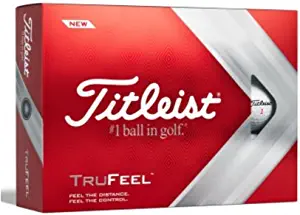
3. Titleist TruFeel — Best Trusted Brand Senior Ball

Titleist TruFeel golf balls

The TruFeel is Titleist’s answer for the senior who wants a name-brand ball without paying urethane prices. 60 compression puts it squarely in the soft band, and the TruFlex ionomer cover feels noticeably softer around the greens than pure Surlyn. It’s not a full-hybrid cover like the Supersoft, but Titleist’s core-and-mantle work is genuinely refined — this ball plays well across a wide swing-speed range from 70 to 95 mph.

The visible differentiator is Titleist’s red alignment aid printed on every ball. Real on-course benefit if you struggle to line up putts. And for many seniors, brand trust matters — Titleist has been the reference golf ball manufacturer for 40+ years, and the TruFeel benefits from that halo.

Best for: Driver swing 75-95 mph. Seniors who prefer name-brand equipment and want a visible alignment aid.

Honest weakness: at $30 per dozen it’s pricier than the Supersoft or e6 Soft for a similar performance tier. You’re paying about $5/doz for the Titleist logo.

Titleist TruFeel
4.2/5
Distance4.1
Greenside3.8
Feel4.6
Value4.3

Check Latest Pricing

4. Bridgestone e6 Soft — Best High-Launch Senior Ball

Bridgestone e6 Soft golf balls

Bridgestone’s e6 series has been designed around “get the ball airborne easily and fly it straight” for decades. For a senior with a slower swing, that’s exactly the fitting priority — a ball that launches high enough to carry the front bunker instead of skipping into it. 40 compression makes it feel soft at impact, and the dimple pattern is tuned specifically for high launch at moderate ball speeds.

The e6’s second superpower: reduced sidespin off the driver. If your miss is a slice or fade, the e6 fights the curve — less sidespin means straighter ball flight and more fairways hit. That’s a genuine scoring lever for a senior who’s fighting slice-driven lost balls.

Best for: Driver swing 70-90 mph. Seniors who struggle to keep the ball airborne, chronic slicers.

Honest weakness: ionomer cover means minimal greenside spin. Wedge shots release forward instead of checking up.

Bridgestone e6 Soft
4.2/5
Distance4.2
Greenside3.5
Feel4.4
Value4.7

Check Latest Pricing

5. Srixon Soft Feel — Best Budget Name-Brand

Srixon Soft Feel golf balls

Srixon’s Soft Feel is the cheapest name-brand ball from a company that also makes tour-level products (Z-Star line). At $25 per dozen and 60 compression, it competes directly with the Supersoft on softness while adding Srixon’s 338 Speed Dimple pattern — a dimple design that flies noticeably straighter through crosswinds than most balls in this price range.

If you play a course with a lot of exposed holes, wind resistance matters more than most golfers realize. The Soft Feel is one of the few sub-$30 balls with dimple engineering that materially reduces wind-drift on approach shots.

Best for: Driver swing 75-95 mph. Seniors playing exposed courses, budget-conscious golfers who want a trusted mid-tier brand.

Honest weakness: Soft Feel releases forward on greenside chips. Not a “check up” ball. If short-game precision matters more than everything else, the Tour B RXS below is the fit.

Srixon Soft Feel
4.2/5
Distance4.0
Greenside3.4
Feel4.5
Value4.9

Check Latest Pricing

6. Kirkland Signature Performance+ — Best Value Urethane

Kirkland Signature Performance+ / 3-piece golf balls

Costco’s Kirkland Signature Performance+ is the outlier on this list. It’s a genuine 3-piece urethane ball at $25 per dozen — 3-piece urethane construction is what Pro V1 and Chrome Tour deliver at $55+ per dozen. That’s not a typo. The 2025 refresh fixed the diameter-consistency issues that plagued earlier versions.

Compression is 95 — mid-firm — which means this ball fits a senior with a still-fast swing (90+ mph) far better than it fits an 80 mph swinger. If you’re in that faster-swinging-senior bracket AND your wedge contact is clean enough to engage the urethane cover, this delivers Pro V1-adjacent performance for less than half the price. That’s real value.

Best for: Costco members with driver swing 90-105 mph and consistent wedge contact.

Honest weakness: the 95 compression is too firm for most slower-swing seniors. Also, availability is inconsistent — Kirkland sells out and disappears for months at a time.

Kirkland Signature Performance+ / 3-piece
4.5/5
Distance4.4
Greenside4.3
Feel4.3
Value5.0

Check Latest Pricing

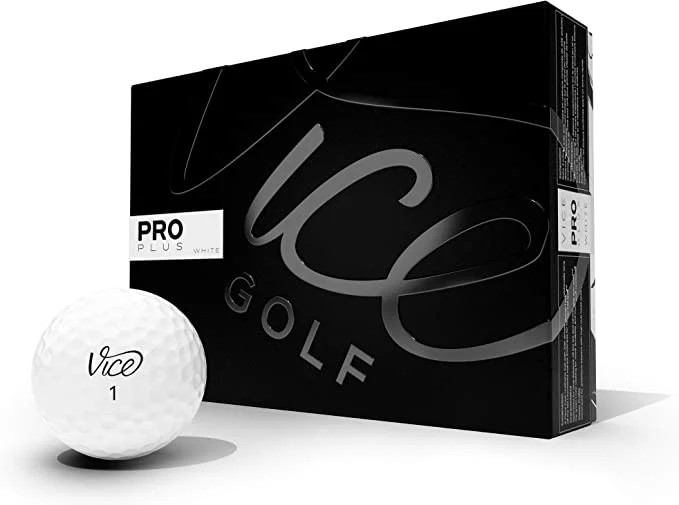
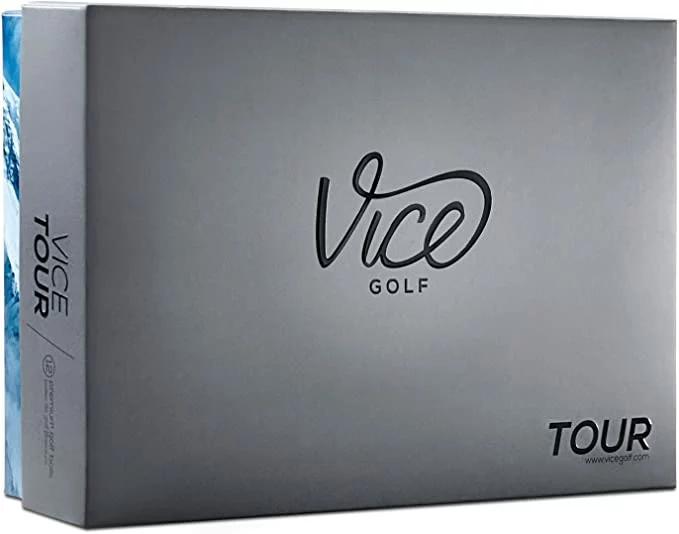
7. Vice Tour — Best DTC 3-Piece

Vice Tour golf balls

Vice’s Tour is a 3-piece ionomer ball delivered direct-to-consumer from Vice’s website. The 3-piece construction gives you slightly softer feel and marginally more greenside behavior than a standard 2-piece ionomer, though it doesn’t grab like true urethane. 95 compression targets the faster-swinging senior (85-100 mph) specifically.

Where Vice wins is the delivery model. Buy 3 dozen at a time on subscription, they show up at your door on a schedule, no pro-shop scramble. For a senior who plays regularly and hates equipment logistics, that convenience is genuinely valuable.

Best for: Driver swing 85-100 mph. Seniors who want DTC delivery and a slightly more premium feel than 2-piece ionomer.

Honest weakness: not available in retail — can’t try a sleeve before committing to 3 dozen. Wrong compression band for slower swings (under 85 mph).

Vice Tour
4.3/5
Distance4.3
Greenside4.2
Feel4.1
Value4.8

Check Latest Pricing

8. Bridgestone Tour B RXS — Best Premium Soft

Bridgestone Tour B RXS golf balls

The Tour B RXS is the softest ball in Bridgestone’s premium Tour B lineup — 70 catalog compression, real urethane cover, higher launch off the face than most premium urethanes. That last piece matters most for seniors: a ball that launches high enough to hold a firm green from a 130-yard approach is a real scoring lever, and the Tour B RXS is engineered for exactly that.

Bridgestone’s Reactive iQ cover is genuine premium urethane — spin rates on chip shots measure close to Pro V1. If short-game control is where your scoring bottleneck lives and your wedge contact quality has held up as you’ve aged, this is the ball that translates the premium price into actual strokes saved.

Best for: Driver swing 80-95 mph. Seniors with reliable wedge contact who value greenside spin and higher launch.

Honest weakness: $55 per dozen. If your wedge contact is inconsistent, the urethane advantage doesn’t fully convert to strokes. The Supersoft or TruFeel at half the price serves you better.

Bridgestone Tour B RXS
4.4/5
Distance4.4
Greenside4.7
Feel4.6
Value3.7

Check Latest Pricing

9. Titleist AVX — Best Pro V1 Alternative for Faster Seniors

Titleist AVX golf balls

The AVX is Titleist’s softer, lower-spinning premium urethane ball. Compression is 78 — softer than Pro V1’s 90 — and the flight is lower with less driver spin. For a senior with a still-competent swing (90+ mph) who wants Titleist tour-level construction but with a softer feel and less spin ballooning, the AVX is the exact fit.

The AVX doesn’t grab quite as hard as a Pro V1 around the greens, but for most senior golfers that gap doesn’t affect scoring — you’re not sticking wedges inside 5 feet enough for the spin difference to matter. What you do get is a softer feel and a lower, more penetrating ball flight that plays well in wind.

Best for: Driver swing 90-105 mph. Seniors who like the Pro V1 idea but find its feel too firm and its spin too high.

Honest weakness: $55 per dozen for a ball whose greenside spin advantage over the TruFeel is small at senior swing speeds. Only worth it if you’re playing well enough for the premium characteristics to convert to strokes.

Titleist AVX
4.2/5
Distance4.5
Greenside4.0
Feel4.6
Value3.7

Check Latest Pricing

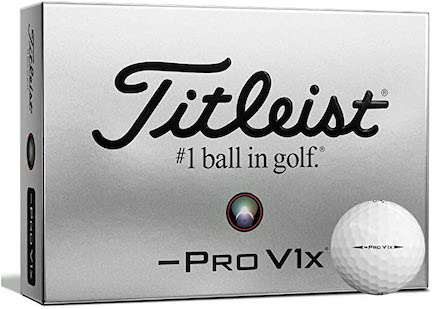
10. Titleist Pro V1x Left Dash — Best for 100+ mph Seniors

Titleist Pro V1x Left Dash golf balls

Some seniors kept every mile per hour of clubhead speed. If that’s you — 100+ mph driver, still hitting 260-plus off the tee, wondering why every “senior ball” list is recommending 50-compression Supersofts — the Pro V1x Left Dash is the answer. This is the firmest ball in the Pro V1 line (102 compression), tuned specifically for high-speed players who want lower driver spin and tighter dispersion at bomber-swing speeds.

Playing a slow-swing ball at 105 mph gives up distance because the ball over-compresses. The Left Dash is what you use to fully leverage the swing speed you still have.

Best for: Driver swing 100+ mph, low-handicap seniors, still-competitive senior tournament players.

Honest weakness: $58 per dozen — the most expensive ball on this list. Also the wrong ball for 95% of the senior population. Only fits if you genuinely have the swing speed to compress it.

Titleist Pro V1x Left Dash
4.1/5
Distance4.9
Greenside4.3
Feel3.8
Value3.2

Check Latest Pricing

Distance-Boosting Non-Conforming Balls: Legit or Marketing?

Every senior golfer eventually sees the ads: “Play 30 yards longer with our NON-CONFORMING distance ball!” Polara, MG Senior, Bandit — all marketed at seniors as a way to buy back distance you’ve lost to age.

The physics is real. Non-conforming balls exceed the USGA’s initial velocity limit or aerodynamic-symmetry rules and can genuinely fly 10-20 yards farther for a given swing speed. Some (Polara Ultimate Straight) also use asymmetric dimple patterns that reduce sidespin, which correcting a slice more aggressively than any legal ball can.

The catch is unambiguous: non-conforming balls are not legal for tournament play or handicap posting. Play them for casual rounds, scrambles, or match play with your friends and you’re fine. Post a round played with a non-conforming ball to your handicap and you’re violating the rules of golf.

Honest verdict for a senior:

  • If you play strictly casual rounds and don’t post scores: non-conforming balls can be a legitimate fun-preserving choice. The distance you get back is real.
  • If you post scores for a handicap, play in your club’s flighted senior events, or maintain any kind of competitive standing: play a conforming ball. Full stop. The 10-yard distance boost isn’t worth the DQ risk or the handicap integrity issue.
  • The straightening effect of asymmetric dimples (Polara) is real for chronic slicers, but the same effect is available in legal balls — the Bridgestone e6 Soft on this list uses conforming dimple design specifically to reduce sidespin, and it works.

Most manufacturers marketing “senior distance balls” carefully label them “USGA conforming” — the truly non-conforming ones bury that detail in the fine print. Read the packaging before buying.

Cost Analysis: Balls Lost Per Round

Ball cost is a real line item for any regular golfer. If you play once a week and lose 2 balls per round, here’s what each ball on this list actually costs you:

BallPrice/dozCost per ball2 balls lost/round3 balls lost/round
Titleist Pro V1x Left Dash$58$4.83$9.67$14.50
Titleist AVX / Bridgestone Tour B RXS$55$4.58$9.17$13.75
Titleist TruFeel / Vice Tour$30$2.50$5.00$7.50
Callaway Supersoft / Srixon Soft Feel / Bridgestone e6 Soft$25$2.08$4.17$6.25
Kirkland Sig. Performance+$25$2.08$4.17$6.25
Wilson Duo Soft$20$1.67$3.33$5.00
Cost per round at 2 or 3 balls lost per round.

If you play 40 rounds a year and lose 2 balls per round, the gap between a Pro V1x Left Dash and a Duo Soft is $253 per year. That’s meaningful money. And unless your swing speed is actually 100+ mph and your wedge game is genuinely sharp, that $253 isn’t buying you strokes — it’s buying you brand.

Should a Senior Play a Premium Ball?

Direct answer: depends more on your swing speed and wedge contact than your handicap. Premium urethane balls (Pro V1, Chrome Tour, TP5, Tour B family, AVX, Left Dash) deliver three specific advantages: greenside spin, tighter dispersion at higher swing speeds, and premium feel. All three are real. All three convert to strokes only when your game can use them.

A senior with a 78 mph swing playing a Pro V1 isn’t getting most of that value back. The dispersion advantage requires speed to matter. The greenside spin only helps if you’re consistently landing wedge shots inside 15 feet. And premium feel is real, but paying $30 extra per dozen for feel alone is a personal choice, not a scoring optimization.

The exceptions where premium makes sense for a senior:

  • Your swing speed is above 90 mph AND you consistently land wedge shots on the green
  • Your short game is your strength and greenside spin genuinely translates to strokes for you
  • Feel is important enough to you that you’d pay $30 extra per dozen for it as a comfort/enjoyment upgrade

If none of those apply, save the money. The Supersoft, TruFeel, or Kirkland Performance+ delivers what your game can actually use, at a fraction of the cost.

Frequently Asked Questions

What counts as a senior golfer for ball fitting?

Age doesn’t drive the fitting decision. Swing speed does. Most golfers over 60 have lost some clubhead speed, which is why “senior” and “slow swing” get conflated in most ball roundups. But plenty of 65-year-olds still swing 100 mph, and plenty of 45-year-olds have lost speed to injury. Fit to your actual current swing speed, not your birth certificate.

What is the best golf ball for a senior golfer in 2026?

For most seniors with a slower swing (70-90 mph), the Callaway Supersoft at $25 per dozen is the best all-around pick. 50 compression, hybrid cover, soft feel, decent greenside grab. For the softest feel, the Wilson Duo Soft. For a trusted brand, the Titleist TruFeel. For faster-swinging seniors (95+ mph), the Titleist AVX or Bridgestone Tour B RXS.

Can changing golf balls get me distance back?

Only modestly. If you’re playing a ball with wrong compression for your swing speed, switching to a correctly matched ball can be worth 3-8 yards from better energy transfer and appropriate spin. That’s real, but it’s not going to restore the 30 yards you’ve lost since your peak. For meaningful distance gain, look at swing-speed training like the Stack System or professional swing-speed coaching. Ball choice is a tuning lever, not a rebuild.

Do low compression balls give slow swings more distance?

Not really. This is one of the most repeated marketing myths in golf. Modern launch monitor data has consistently shown ball speed differences under 1 mph between soft (50-compression) and mid (70-compression) balls at slow swing speeds. Low compression gives you a softer feel and slightly higher launch. Both are legitimate reasons to choose a soft ball. Neither one is worth 5+ yards of distance.

Are non-conforming distance golf balls legal to use?

For casual rounds, yes. For any round you post to your handicap or play in tournament competition, no — non-conforming balls violate the rules of golf. Polara, MG Senior, and similar distance-boosting non-conforming balls are marketed heavily at seniors but should only be played in scrambles, match play among friends, or casual practice rounds. Read the packaging — legal balls are labeled “USGA conforming.”

Should a senior always play a soft ball?

No. Match compression to your swing speed. If you swing 100+ mph, a soft ball over-compresses and gives up distance. The Left Dash, Vice Tour, or Kirkland Performance+ fits a fast-swinging senior far better than the Supersoft or Duo Soft would. “Senior = soft” is an oversimplification that costs still-fast seniors real distance.

Final Verdict

The “senior golf ball” category is real, but the fitting logic is simpler than most articles make it look. Get your driver swing speed measured. Match compression to that speed. Pick within the compression band based on cover material (ionomer vs urethane) and price.

  • Under 75 mph: Wilson Duo Soft or Callaway Supersoft — softest feel, easy launch
  • 75-90 mph: Callaway Supersoft, Titleist TruFeel, or Bridgestone e6 Soft — the slow-swing sweet spot
  • 85-100 mph: Bridgestone Tour B RXS or Titleist AVX (if premium is worth it), or Vice Tour / Kirkland Performance+ (if value matters more)
  • 100+ mph: Titleist Pro V1x Left Dash — you’re not a “senior ball” reader anyway

Play the same ball every round for a full season. That’s the only way to fit yourself properly — track your scores, note your dispersion, and let the data tell you if a switch would help. Ball-hopping every round is how you never learn what your equipment is actually doing.

Related reading: Best Golf Balls for Slow Swing Speeds | Best Golf Balls for High Handicappers | Best Cheap Golf Balls | What Golf Ball Compression Actually Means | Estimate Your Swing Speed | Get Speed Back with the Stack System

Scroll to Top