
Last updated: September 5, 2026
⛳️ Our experts spend hours testing golf balls on the launch monitor, on-course, and reading every independent lab report we can find, before recommending anything. When you make a purchase through one of our links, we may earn a small affiliate commission, at no cost to you. Find out more about how we test products.
Quick Verdict: Are Noodle Golf Balls Any Good?
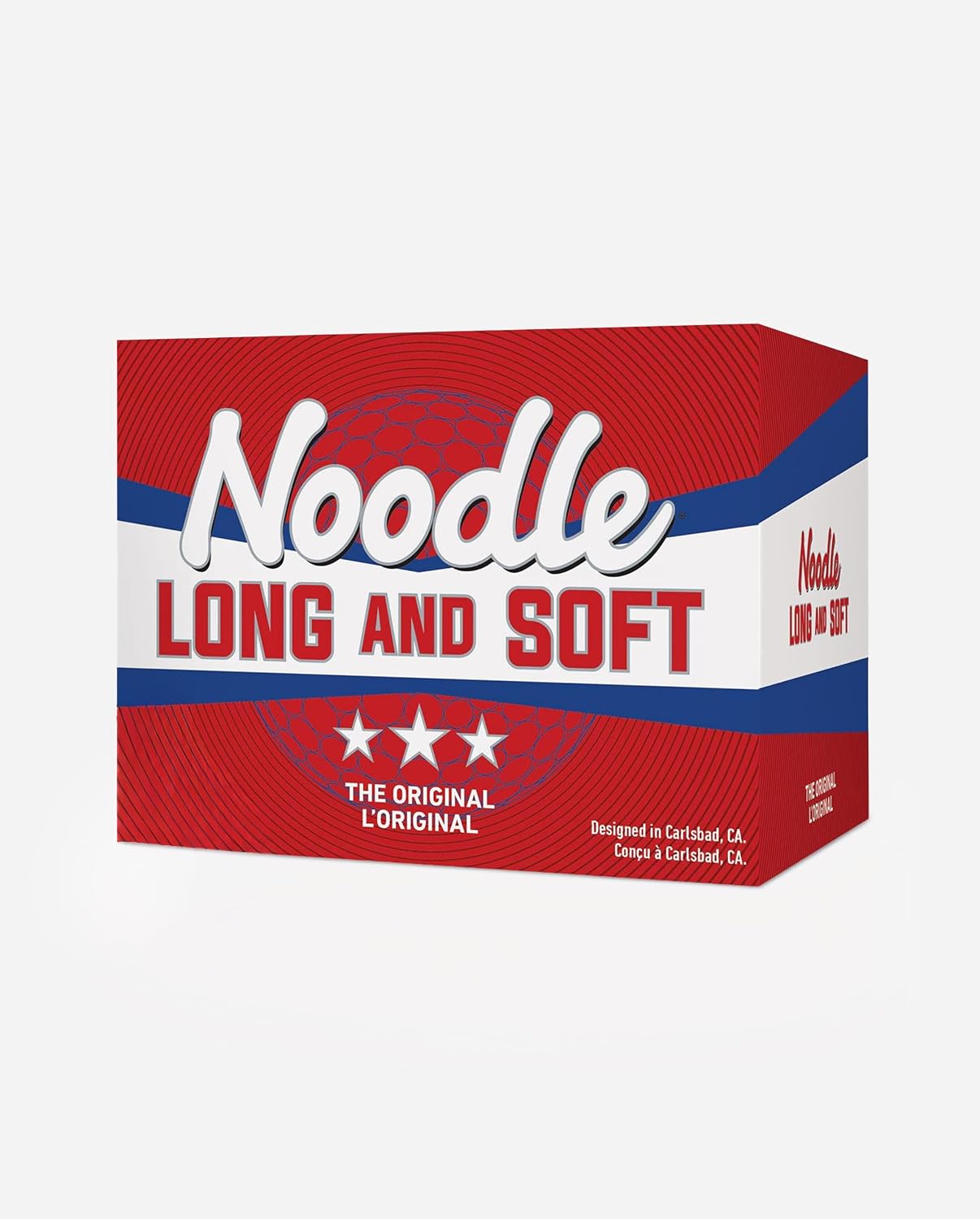
Yes — for the right golfer. The TaylorMade Noodle Long & Soft is a 2-piece Surlyn-covered ball priced around $1 to $2 per ball, aimed at moderate-to-slow swing speeds (roughly 70-95 mph driver), high handicappers, beginners, and any player who loses more than one ball a round. It flies straight, delivers respectable distance, and does not check up on the greens. That last part is the trade-off — you’re buying a cheap 2-piece ionomer, not a tour ball, and the greenside spin gap is real.
I’ve played the Noodle off and on for well over a decade. When I ran it head-to-head against the Srixon Soft Feel and Bridgestone e6 on my GC3 launch monitor, the Noodle held its own on distance, beat both on driver spin, and lagged them around the greens. Every independent review lands in the same place. The Noodle isn’t the best cheap ball for everyone — but it’s a legitimate pick for the golfer who needs one.
Who The Noodle Is For (And Who It Isn’t)
The Noodle Long & Soft fits you if:
- Driver swing speed 70-95 mph. Faster swings over-compress the ball and give up ball speed. The Noodle rewards a smooth, controlled swing more than a bomber’s.
- You lose 2+ balls per round. At $1-2 per ball, the hit to your wallet is minimal even on a rough day.
- Your short game isn’t built around spinning wedges. If your typical chip is a bump-and-run or a low pitch, the Noodle’s limited greenside spin won’t cost you strokes.
- You’re new to golf. Beginners rarely engage a urethane cover cleanly enough to benefit from one, so paying for a tour ball is money out the window.
- You play casual, social golf where score isn’t the point. Save the tour balls for rounds that matter.
The Noodle is the wrong ball for you if:
- Driver swing speed above 95 mph. A firmer, higher-compression ball (Titleist Velocity, TaylorMade Distance+, Vice Pro) will give you more ball speed at that swing.
- You stick wedge shots close and want them to hold. The Noodle’s ionomer cover produces roughly 30-40% less wedge spin than a urethane cover. If you rely on wedge check, this isn’t your ball.
- You want genuinely soft feel. The name is marketing — MyGolfSpy Ball Lab measured 69 compression, squarely mid-compression. The Wilson Duo Soft (measured 35) or Callaway Supersoft (measured 38) feel noticeably softer.
- You play competition golf and care about ball-to-ball consistency. MGS flagged 11% of their Noodle sample as “bad” balls (concentricity issues), and one of three sample dozens ran meaningfully different in compression, weight, and diameter than the other two. Fine for a weekend round; not for a tournament bag.
Noodle Long & Soft vs Noodle Easy Distance: Two Different Balls
TaylorMade sells two Noodle models under the same brand name, and most reviews conflate them. They’re different balls with different fits.
| Noodle Long & Soft | Noodle Easy Distance | |
|---|---|---|
| Cover | Surlyn / Iothane ionomer | Ionomer (anti-scuff variant) |
| Marketed compression | 34 (ultra-soft claim) | ~50 (soft claim) |
| MGS measured | 69 (mid-compression) | Not lab-measured |
| Target swing speed | 70-95 mph driver | Under 85 mph driver |
| Price / dozen | $19-25 | $18-22 |
| Best for | Beginners, high handicappers, moderate swings | Juniors, seniors, very slow swings under 85 mph |
This review covers the Long & Soft — the more common of the two and the one that shows up in most “cheap ball” recommendations. Shopping for a family member with a genuinely slow swing (older senior, younger junior)? Look at the Easy Distance instead — the softer compression and forgiveness profile is better tuned for sub-85 mph swings.
Compression, Construction, and the Long & Soft Name
TaylorMade markets the Noodle Long & Soft with a 34-compression claim, which would put it in the ultra-soft tier alongside the Wilson Duo Soft and Callaway Supersoft. That claim is where the “soft” in the name comes from. It’s also where the story gets interesting.
MyGolfSpy Ball Lab — the most-cited independent audit in the golf ball world — runs every popular ball through the same compression gauge, not the manufacturer’s spec sheet. On the Noodle Long & Soft they measured 69 compression. That’s not ultra-soft. It’s squarely mid-compression, in the same band as many “regular” 2-piece balls that don’t market themselves as soft at all. Cross-brand compression numbers aren’t comparable (a Callaway 90 and a Titleist 90 aren’t measured the same way), so MGS’s gauge is the apples-to-apples reference for shopping.
A 69-compression ball still feels softer than a Pro V1 because the ionomer cover softens impact regardless of core compression — that’s where the “soft” impression comes from at address and off the wedge. But it isn’t a soft-feel ball in the way a Duo Soft or Supersoft is. The upside: faster swingers don’t over-compress it as easily as they would a 35-compression ball, which is actually good for the 90-100 mph swinger. Bottom line: the name is a little misleading, but the ball itself is well-tuned for the 70-95 mph band.
| Manufacturer | TaylorMade (manufactured in Korea) |
| Construction | 2-piece: ultra-soft core, Surlyn / Iothane cover |
| Dimples | 342 aerodynamic pattern |
| Marketed / MGS compression | 34 marketed / 69 measured |
| USGA status | Conforming |
| Price / dozen | $19-25; 24-ball value packs at Walmart, Amazon, Dick’s |
| MGS True Price | $13.55 (accounting for off-spec balls in each dozen) |
A small piece of history worth knowing: the Noodle brand was originally part of the Maxfli family. When Dick’s Sporting Goods bought Maxfli in 2008, TaylorMade kept the Noodle name for themselves. The ball is still manufactured at the same Korean facility it always was, so a modern Noodle carries roots in the mid-2000s Maxfli distance-ball lineage — updated periodically, familiar in spirit.
My Simulator Test: Noodle vs Srixon Soft Feel vs Bridgestone e6
I’ve hit thousands of balls in my home simulator on a Foresight GC3 launch monitor. To answer the “is the Noodle actually good?” question with more than a gut check, I ran it against two other cheap balls I keep in the bag rotation: the Srixon Soft Feel ($22/doz) and the Bridgestone e6 Soft ($29/doz).
- Off the tee (driver): the Noodle produced the lowest spin numbers of the three — the classic 2-piece ionomer signature. Low spin, high launch, straight ball flight. Carry distance was within a couple of yards of both alternatives. If you slice or hook, the Noodle’s low spin is legitimately helpful.
- Mid-irons (7-iron): the Noodle spun slightly higher than either competitor. Not by a huge margin, but enough that it held greens marginally better on mid-iron approaches. Unusual result for a cheap ball — usually cheap ionomers all spin similarly with irons.
- Greenside (56° wedge, half swing): the Noodle produced the lowest greenside spin of the three. This is where the Soft Feel and e6 both outperform it. Flop shots and check-up pitches will roll out further than either alternative.
I followed up with an on-course round using the Noodle exclusively. Straight flights, respectable carry, no complaints tee-to-green. Three chips from just off the green rolled 5-7 yards past the pin on landing — matches the simulator finding on greenside spin. Not a bug for a beginner or high handicapper who’s going to run chips up to the pin anyway, but a real ceiling for anyone trying to spin a wedge shot backward.
On-Course Performance
Beyond the launch monitor, here’s what playing a full round with the Noodle actually looks like:
- Driver: straight ball flight is the Noodle’s headline feature. Low spin resists exaggerating slice or hook. If sidespin is your enemy off the tee, this produces fewer trouble balls than a higher-spin option. Distance is good enough — not the longest, not short.
- Fairway metals, hybrids, long irons: straight, moderate launch, adequate distance. Nothing surprising. Mid and long irons climb — high launch is baked into the design. Naturally low ball flight? This helps. Already a high ball hitter? The ball can occasionally balloon in wind.
- Wedges and short game: the tradeoff lives here. Chip-and-run, bump-and-run, and low-launch pitches work fine. Anything requiring spin — a flop shot, a pitch that needs to check — will run out further than you’re used to. Adjust your landing spot forward on approach shots to compensate.
- Greenside spin gap: a 2-piece Surlyn ball produces roughly 30-40% less wedge spin than a urethane tour ball on clean lies. That isn’t a Noodle-specific problem — every ball in this construction category has the same ceiling. And urethane’s advantage only shows up when your ball-striking is clean enough to engage the cover, which is why the Noodle plays roughly the same as a $55 tour ball on a fat or thin wedge for most amateurs.
- Putting: reasonable feel off the putter face. Not clicky, not dead. Unmemorable in either direction.
- Durability: the ionomer cover holds up through an 18-hole round on clean strikes. Cart-path grinds will scuff it like any ionomer ball.
Pros and Cons
Pros
- Excellent price-to-performance at $1-2 per ball
- Straight ball flight helps beginners and slicers keep it in play
- Adequate distance at moderate swing speeds (70-95 mph)
- TaylorMade quality control — not a discount-brand build
- Widely available at Walmart, Amazon, Dick’s, and pro shops
- USGA-conforming — legal for all forms of play
Cons
- Name is misleading — MGS measured 69 compression, not “ultra-soft”
- Limited greenside spin, especially on flop and pitch shots
- Occasional box-to-box variance in compression, weight, and diameter
- 11% “bad ball” rate in MGS’s audit (concentricity issues)
- High launch can balloon shots in windy conditions
- Not ideal for driver swings above 95 mph
Price, Where to Buy, and 3 Alternatives
The Noodle Long & Soft sells for $19-25 per dozen, with 24-ball value packs at Walmart, Dick’s, and Amazon that bring the per-ball price to about $1. Bulk 2-dozen boxes are usually the best deal. MyGolfSpy’s True Price metric — an estimate of what you’d effectively pay after accounting for bad balls in each pack — comes in at $13.55 for the Noodle, about 13% above retail. That’s typical for cheap 2-piece balls, not a red flag.
Three other cheap-tier balls are consistently competitive with the Noodle. Aggregate scores below are from my ball database:
Callaway Supersoft — genuinely soft, best-seller
The default “genuinely soft” cheap ball. MGS measured 44 compression — noticeably softer feel than the Noodle. Slightly better greenside spin. $25/dozen. If you want soft feel and can spend a few dollars more, this is your ball.
Srixon Soft Feel — best slow-swing value
The one I recommend most often to slow-swing amateurs. Marketed 60 compression — softer than the Noodle, firmer than the Supersoft — with better greenside spin than either. $22/dozen. A “just works” ball at the price; a coin-flip with the Supersoft depending on which side of the soft/firm line you prefer.
Bridgestone e6 Soft — best anti-slice cheap
MGS measured 40 compression. Bridgestone’s dimple engineering is tuned to reduce sidespin — meaningfully helpful if you slice off the driver. $24/dozen at the top of the cheap band. If straight ball flight is your primary need, this is a legitimate alternative to the Noodle with softer feel.
Frequently Asked Questions
Are TaylorMade Noodle golf balls actually any good?
Yes, for the right golfer. The Noodle Long & Soft is a well-made 2-piece ionomer at about $1-2 per ball, ideal for beginners, high handicappers, and moderate swing speeds (roughly 70-95 mph driver). It flies straight, gets adequate distance, and won’t hurt your wallet when you lose one in the pond. The catch is limited greenside spin — if your short game depends on wedge shots checking up, this isn’t your ball.
What is the actual compression of a Noodle golf ball?
TaylorMade markets the Long & Soft with a 34-compression claim, but MyGolfSpy Ball Lab measured it at 69 on their gauge — squarely mid-compression, not the ultra-soft the name implies. The ionomer cover softens the impact feel regardless of core compression, so it feels softer than a Pro V1 despite being firmer than the name suggests. If you want a genuinely low-compression soft feel, the Wilson Duo Soft (measured 35) or Callaway Supersoft (measured 38) are the actual soft balls in the cheap tier.
What swing speed is the Noodle designed for?
Driver swing speeds of roughly 70-95 mph. Faster than that and you’ll over-compress the ball, losing ball speed. Slower than that and you may benefit more from the Noodle’s softer sibling, the Easy Distance, which is tuned for sub-85 mph swings. Ball fitting is about swing speed, not handicap — plenty of high handicappers swing 100+ mph and fit better into a firmer ball category regardless of skill level.
Noodle vs Callaway Supersoft — which is better?
Different balls for different priorities. Noodle is the cheapest option (about $1 per ball in 2-dozen packs), has straighter flight, and delivers slightly better mid-iron spin. Supersoft is $25 per dozen, genuinely softer feel (measured 44 vs 69), and slightly better greenside spin. If you want the absolute cheapest, Noodle. If you want soft feel, Supersoft. Both are legitimately good for the price.
Who makes Noodle golf balls?
TaylorMade owns the Noodle brand today. The name was originally part of the Maxfli family — when Dick’s Sporting Goods bought Maxfli in 2008, TaylorMade kept Noodle for themselves. Manufacturing continues at the same Korean facility, under TaylorMade’s ownership and quality control.
Final Verdict
The TaylorMade Noodle Long & Soft is a legitimately good cheap golf ball — with an asterisk. The name is misleading (it’s not ultra-soft; MGS measured 69 compression), and greenside spin is limited compared to urethane options. But at about $1 to $2 per ball, with straight flight, adequate distance for moderate swings, and TaylorMade’s quality control behind it, the Noodle earns its spot in the cheap-ball tier.
Buy it if you’re a beginner, high handicapper, or moderate-swing amateur who loses more than a couple of balls per round and doesn’t need wedge check on your short game. Skip it if your swing speed is over 95 mph, if you rely on greenside spin, or if you want a genuinely soft-feeling ball. My GC3 test backs it up: straight flight, respectable distance, weak greenside. Same story every independent review tells. The Noodle isn’t magic — it’s a well-priced 2-piece ionomer that does exactly what a 2-piece ionomer does. For the right player, that’s exactly enough.
Related reading: Best Cheap Golf Balls 2026 | Best Golf Balls for High Handicappers | Best Golf Balls for Slow Swing Speeds