
Last updated: September 4, 2026
⛳️ Our experts spend hours gathering data, testing, and comparing products to deliver comprehensive recommendations to help you choose. When you make a purchase through one of our links, we may earn a small affiliate commission, at no cost to you. Find out more about how we test products.
Quick Verdict: Is the ProSENDR Worth It?
After three months of daily practice with the ProSENDR — and after using it side-by-side with HackMotion to measure what it does to lead-wrist angle — the short answer is yes, if you’ll actually work with it. It puts your lead wrist into a neutral position on every swing where your trail hand is in the cradle, my HackMotion sessions prove it, and my wife’s chronic out-to-in slice turned into a slight draw inside a month. The $299 wrist-cradle-plus-video-library bundle isn’t cheap, but it’s the only training aid I own that both of us kept using after the novelty wore off. If you want a quick fix or a “no thought” club to swing until you get better, this isn’t it. Buy it if you’re willing to run the video progressions and hit slow, focused reps for weeks — not sessions.
Note: no affiliate kickback on the ProSENDR — no discount code, no commission. This review is 100% unbiased. Author is currently a 7.7-handicap working down toward 4, using the ProSENDR alongside Stack System speed training and HackMotion feedback.
What Is the ProSENDR?
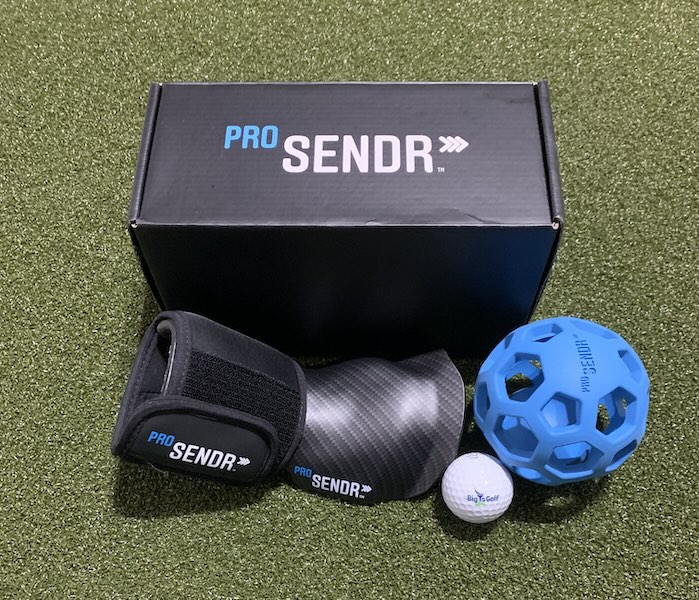
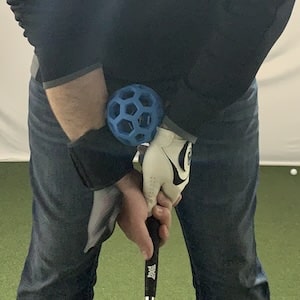
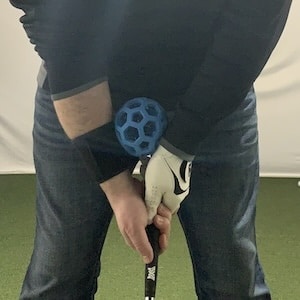
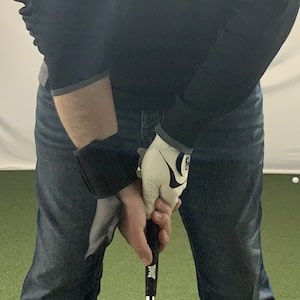
The ProSENDR is a multi-use wrist training aid built by David Woods and PGA Tour coach Sean Foley. It comes with two pieces — a wrist cradle that straps to your trail wrist and a compression sphere you hold between your forearms — and you can use them independently or at the same time. That makes it effectively a 3-in-1 aid: cradle only, sphere only, or both together.
The wrist cradle sits over the back of your trail hand at the average lead-wrist angle a Tour pro produces at the top. When your hand is in the cradle, your lead wrist is in a neutral position — flat, not cupped, not bowed. That prevents the over-cocked, casting position most amateurs get into at the top of the backswing and keeps you square coming down.
The compression sphere is a pliable ball with a velcro wrist strap. Held between your forearms, it forces your elbows closer together and creates width in your swing. More width means more distance from the ball at the top, more room for the club to travel, and more speed.
ProSENDR Price and What’s in the Box (2026)
ProSENDR sells direct through prosendrgolf.com. Current pricing:
| Bundle | Price (2026) | What you get |
|---|---|---|
| Wrist Cradle | $299 | Cradle + compression sphere + free training video library (fundamentals + basic practice progressions) |
| Eagle Bundle | ~$399 | Everything above + advanced protocol videos + dedicated short-game training + drills library |
I own the Eagle bundle. The advanced videos add real value once you’ve spent a few weeks on the fundamentals — they get into transition sequencing, short-game feel, and the specific drills Sean Foley uses with Tour players. That said, the base wrist-cradle package with the free video library gets you 80% of the benefit. Start there. Upgrade to Eagle later if you’re still using it after 4-6 weeks (that’s the honest gate — plenty of training aids end up in a drawer, and $100 extra on advanced videos you never watch is money burned).
The videos matter more than most reviews admit. Without them I’d have tossed this thing after session one. With them, the progressions actually build on each other and you can see why each rep is being done a specific way.
My 3-Month Test: HackMotion Validation
Here’s the piece no other ProSENDR review has: I own HackMotion, which measures actual lead-wrist angle with a sensor on the back of your glove. So I strapped HackMotion on the lead wrist, ProSENDR on the trail wrist, and hit shots.
What my baseline HackMotion data shows about my swing: I flex my lead wrist through impact — that closes the clubface and is a big part of my hard-left miss. Not a subtle tendency, it’s real, and every third or fourth swing gets punished for it.
What HackMotion shows when I’m wearing the ProSENDR and my trail hand is in the cradle: lead wrist neutral. Every single swing. Not most swings. Every one.
That’s a direct, measured validation of the manufacturer’s claim. When your trail hand is where the cradle puts it, your lead wrist has no choice but to sit flat. The geometry doesn’t lie. Every top-of-swing photo the ProSENDR marketing team shows you? HackMotion confirms the wrist angle on my actual body matches that image when I’m using the aid.
The harder question — does the pattern hold after you take the aid off? That’s what three months of practice was for. The short answer is yes, mostly. My HackMotion sessions without the ProSENDR now show a much narrower band of lead-wrist flexion at impact than my baseline. Not perfect, but the sensor is telling me the training carries over. I’ll keep using it until my HackMotion “wristless” numbers match my “wristed” numbers, which the ProSENDR marketing implies takes 6-12 months of consistent work.
What Changed in My Swing (Hard-Left Miss Gone)
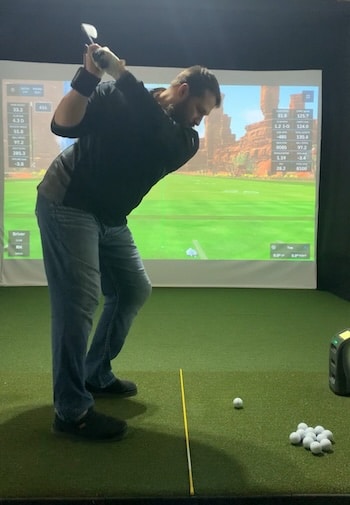
Before the ProSENDR, my miss was always a hard left pull. I’d stop rotating my body at the top but my club would keep going because my wrists kept turning. Coming down, I never held wrist extension — I’d release too early and pull across my body.
Three months in, that miss is mostly gone. My swing feels more controlled but produces higher clubhead speed, which is the counter-intuitive thing about proper wrist mechanics — release later and you both hit it straighter and further, because you’re delivering the clubhead with lag instead of throwing it away 30 degrees early.
Wanted to throw it away after my first session, though. Not going to sugarcoat that. First session I finished, stepped away, tried to figure out what I was doing wrong, followed the videos again — and it still felt “off.” I tried it a couple hours later and it was slightly less bad. Every subsequent session got better. Now it feels normal.
Why did it feel so off? Because my swing sucked. The ProSENDR wasn’t wrong. My positions were wrong, and putting my hand in the correct spot exposed every compensation I’d been making.
My Wife’s Test: Slice → Slight Draw in 1 Month
Jo is a former Olympic pistol shooter — which means she processes repetition and structured practice better than 95% of people. She’s also been fighting an over-the-top, out-to-in swing for as long as she’s played golf. Classic slicer with what looked like no power.
Inside a month with the ProSENDR, her slice was virtually gone. Working through the training progressions, she realized she was casting — throwing the clubhead early instead of storing it. Keeping her trail hand in the cradle longer shallowed her swing. The result: significantly more power and a slight draw, versus the fade/slice she’d been fighting for years and couldn’t correct on her own.
Two very different swing histories — mine (baseball hitter, hard left pull, no width) and hers (over-the-top slicer with no shallowing) — both improved with the same aid. That’s not a coincidence. The ProSENDR isn’t fixing one specific fault; it’s putting the trail hand and lead wrist in objectively neutral positions and letting the rest of the swing sort itself out from there.
Using the Compression Sphere (The Harder Piece)
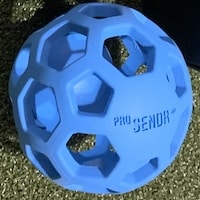
First time I used the sphere I thought I was too heavy, too wide, or not flexible enough. Real answer: I had no width in my swing. Baseball-hitter’s tight-armed pattern from years of playing as a kid. The sphere forces you to keep your forearms and elbows together — the only way to hold it is with connected arms, and connected arms create width by definition.
Sphere sessions are still the frustrating ones. When I come off a sphere session and just hit balls, everything is more compact and consistent. During the session, though, you’re going to feel like you can’t make a swing. That’s the point.
ProSENDR vs HackMotion: Do You Need Both?
I own both. Getting asked whether I’d tell somebody to buy both is fair. Short answer: they solve different problems.
| ProSENDR | HackMotion | |
|---|---|---|
| What it is | Physical training aid (wrist cradle + compression sphere) | Wrist sensor with real-time audio feedback + data app |
| Price | $299 (Wrist Cradle bundle) | $395 (Amateur) / $895 (Pro) |
| What it does | Puts your lead wrist in a neutral position mechanically | Measures your lead wrist angle in real time and beeps when you’re out of range |
| Best for | Ingraining the correct feel over months of practice | Diagnosing exactly what your wrist is doing wrong; verifying training |
| Weakness | Doesn’t tell you if the pattern holds when the cradle is off | Doesn’t force any position — you still have to figure out how to fix it |
They’re complementary, not redundant. HackMotion diagnoses; ProSENDR trains. If you have to pick one and you already know your lead wrist is a problem (early extension, cupped at the top, flipping through impact), get the ProSENDR — it forces the correct position. If you’re not sure what’s wrong yet and want to know exactly which wrist metrics are off, get HackMotion first. Use its data to decide whether you need the ProSENDR after.
The real magic is running them together. HackMotion tells me the ProSENDR is working — objectively, in numbers, on my body. That’s the only way I know this isn’t feel-good confirmation bias.
PGA Tour Players Using ProSENDR in 2026
The Tour list has grown a lot since the ProSENDR launched. Currently confirmed users (2026):
- Wyndham Clark — used the ProSENDR throughout his 2026 U.S. Open win. His coach specifically called out the aid in post-round interviews as part of the wrist work that took him to the title.
- Rory McIlroy — seen using the ProSENDR in warmups and stated it’s helped him control his release through impact.
- Justin Rose — actively working the aid into his practice sessions.
- Erik Van Rooyen — regular user, has credited the aid in swing-change interviews.
- Cameron Champ — uses it primarily for lead-wrist control at the top.
- Alex Cejka — Champions Tour player who’s been vocal about the aid’s impact on his consistency.
- Michael Kim — started using it when he was ranked 350th; now inside the top 100. One of the early public Tour endorsements.
- Justin Thomas — has referenced the aid on social media in the context of Sean Foley’s coaching.
Tour usage isn’t a guarantee anything will work for your swing — pros are pros. But when the same aid keeps showing up in the practice bag of both major-winners (Clark, Rory) and Champions Tour veterans (Cejka), it’s real training, not a promo deal.
Pros and Cons
✅ Pros
- Objective wrist-angle training — HackMotion verifies it works
- Multi-use (cradle only, sphere only, or both)
- High-quality, comfortable materials; fits large and small builds
- Free training video library is genuinely useful — not filler
- Real, measurable results for both users we tested (author + wife)
- Comfortable enough for daily use; both of us are still using it after 3 months
- Uses proper mechanics (release, wrist extension, width) rather than a “swing feel” gimmick
- PGA Tour usage is credible and growing (Wyndham Clark U.S. Open, Rory McIlroy, etc.)
❌ Cons
- $299 is not a casual purchase; more expensive than most training aids
- Requires real time investment — weeks, not one session
- First session can feel awful; adjustment period is real
- Advanced Eagle-bundle videos are an extra $100
- Compression-sphere work is frustrating in the moment
- No app or built-in data feedback (why we pair it with HackMotion)
Who Should NOT Buy the ProSENDR
The ProSENDR isn’t for everyone. If any of the following describe your situation, save your money and buy something else — or nothing.
- You want a quick fix. This isn’t a “swing it once and you’re better” aid. Real change takes weeks of intentional practice.
- You don’t want to watch training videos. The aid without the video progressions is a $299 piece of foam and plastic strapped to your wrist. Doing it wrong is easy.
- You expect improvement without putting in the reps. Both my wife and I saw results, but neither of us just wore it during a range session and called it good.
- Your wrist mechanics are already correct. If your lead wrist is naturally flat and neutral (some players’ are), the ProSENDR doesn’t have anything to teach you. Get a launch monitor instead.
- You’re mid-tournament season and can’t afford a slump. The first 2-3 weeks with any aid that changes wrist positions will make your on-course results temporarily worse. Start in the offseason or during a break.
- You want a “no thought” training aid. This one requires focus during every rep. It rewards deliberate practice; it doesn’t do the work for you.
On the flip side — if you’re a golfer who’s willing to spend 20-30 minutes 3-4 times a week for a couple of months on structured training, and you’ve already identified wrist mechanics or release as a problem, this will genuinely help.
Tips to Get the Most Out of the ProSENDR
- Take a long-term view. Swing changes — especially wrist changes — take time to ingrain. Expect real gains in weeks 3-8, not session 1-2.
- Follow the video progressions. It’s tempting after a few sessions to skip straight to full swings. The video sequences are structured — specific rep counts for specific movements before you make full swings. I get more out of a session when I follow them exactly.
- Separate training and play. Don’t try to make on-course adjustments while learning the new pattern. Do the training work at home or on the range. When you go play, just play. The training will convert to your on-course swing over time — trying to fix it mid-round is how you shoot 92 and quit for a month.
- Pair it with feedback. If you have HackMotion, use them together. If you have a launch monitor, hit balls with and without the aid and watch your dispersion. Objective feedback shortens the learning curve.
- Start with the wrist cradle alone. The compression sphere is more advanced and more frustrating early. Get comfortable with just the cradle for the first couple of weeks.
No affiliation, no kickback — this is a 100% unbiased review.
Frequently Asked Questions
How much does the ProSENDR cost in 2026?
The Wrist Cradle bundle is $299 and includes the cradle, compression sphere, and the free training video library. The Eagle bundle adds advanced protocol videos and short-game drills for around $399 total. Buy the base bundle first — you can upgrade to Eagle after you’ve committed to the training for a few weeks.
ProSENDR vs HackMotion — which should I get first?
They solve different problems. HackMotion diagnoses your wrist angles with data. The ProSENDR mechanically trains your wrist into a neutral position. If you already know your lead wrist is a problem, buy the ProSENDR. If you don’t know what’s wrong yet, HackMotion first, then decide. I use both together — HackMotion verifies the ProSENDR is doing what it claims (it is, my lead wrist reads neutral on every swing).
How long before I see results?
My wife saw her slice noticeably reduce inside a month. My hard-left miss took closer to 6-8 weeks of consistent work to shrink meaningfully. Both of us are still refining after 3 months. Expect the first 1-2 weeks to feel wrong before things start clicking. If you’re 3 sessions in and thinking about quitting, that’s normal — it took me 2-3 tries before it started to make sense.
Does the effect hold when you take the ProSENDR off?
Partially, and it improves with time. My HackMotion sessions without the aid now show a much narrower band of lead-wrist flexion than my baseline — measurable carryover. But the pattern isn’t fully ingrained yet after 3 months. ProSENDR marketing implies 6-12 months of consistent work for the pattern to become automatic. That matches my experience.
Which PGA Tour players use the ProSENDR?
Wyndham Clark used it throughout his 2026 U.S. Open win. Rory McIlroy, Justin Rose, Erik Van Rooyen, Cameron Champ, Michael Kim, Justin Thomas, and Champions Tour player Alex Cejka are all confirmed users. Tour endorsements are a signal, not a guarantee — but seeing the aid stay in Tour bags across multiple seasons is meaningful.
Who is the ProSENDR right for?
Golfers with lead-wrist issues (cupping at the top, flipping through impact, no release) who are willing to put in structured practice time over weeks, not sessions. Not for anyone looking for a quick fix, and not for anyone whose swing mechanics don’t have a wrist problem to fix in the first place.
Final Thoughts
I’m skeptical of most golf training aids — I’ve tried some real duds. The ProSENDR is one of the very few I’ve bought that both my wife and I still use months later. HackMotion confirms it does exactly what the manufacturer claims for lead-wrist angle, and the improvement in both of our on-course misses is real.
If you’re willing to put in structured practice and you know your wrist mechanics are a limiter, this is worth $299. If you want a quick fix or a “no thought” training aid, look elsewhere. Good luck out there — and let us know in the comments how it works for you.
Related — HackMotion Golf Review | The Stack System Review | Swing Speed Training for Golf