
Last updated: September 4, 2026
⛳️ Our experts spend hours gathering data, testing, and comparing products to deliver comprehensive recommendations to help you choose. When you make a purchase through one of our links, we may earn a small affiliate commission, at no cost to you. Find out more about how we test products.
Quick Verdict: Are PXG Golf Balls Worth It?
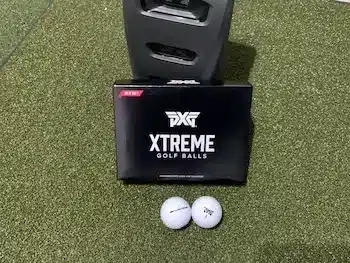
PXG makes three balls now — the original Xtreme ($34.29/doz, 3-piece), the current-generation Xtreme Tour ($34.29/doz, 3-piece urethane) and Xtreme Tour X ($39/doz, 4-piece for higher swing speeds). On my launch monitor the original Xtreme matched the Pro V1 within a couple of yards of carry, with slightly more greenside spin off the wedge and slightly less distance off the tee. The newer Xtreme Tour is what’s replacing it and is the one every 2026 review is measuring. MyGolfSpy’s Ball Lab did a full manufacturing audit on the Xtreme Tour and rated it C-, “Not Recommended,” specifically because of a diameter-consistency problem. My honest bottom line hasn’t changed since 2023: PXG balls are a legitimate performer at 60-70% of Pro V1 pricing, but if you’re not tied to the PXG brand, Vice Pro gives you the same tier of performance for a few bucks less. Full data below.
PXG Ball Lineup (2026): Xtreme, Xtreme Tour, Tour X
PXG launched their original golf ball line in February 2023 — the PXG Xtreme, a 3-piece urethane-covered ball with a 338-dimple design (the same dimple count Bridgestone uses on their premium balls). They’ve since expanded to a three-ball lineup targeting different swing speeds and preferences:
- PXG Xtreme — the original 3-piece urethane ball. Soft feel, moderate compression, priced at $34.29/doz. This is what I tested against the Pro V1 and Vice Pro on my launch monitor. Still in the lineup as the “core” PXG ball.
- PXG Xtreme Tour — the 2025 refresh. Also 3-piece urethane, but tuned firmer for lower driver spin and marketed against the Pro V1 head-on. Compression ~91 (firm-ish). This is the ball MyGolfSpy Ball Lab reviewed in June 2026 — see the manufacturing-quality note further down.
- PXG Xtreme Tour X — the 4-piece variant for higher swing speeds (105+ mph). Firmer, higher launch, marketed as a Pro V1x competitor. Priced at $39/doz. Available in white or bright yellow.
All three are made at the SM Global Vietnam factory — the same factory Kirkland Signature and several other value-tier premium balls come from. That’s part of PXG’s cost story: same manufacturing partner as the balls that make competitors question whether the “big four” (Titleist, Callaway, TaylorMade, Bridgestone) are really that different from the third-party direct-to-consumer balls.
PXG Golf Ball Pricing (2026)
| Ball | Construction | Price / doz (2026) | Compression | Best fit |
|---|---|---|---|---|
| PXG Xtreme (original) | 3-piece urethane | $34.29 | ~85 (mid) | Mid swing speeds, soft feel preference |
| PXG Xtreme Tour | 3-piece urethane | $34.29 | ~91 (firm) | Mid-high speeds, Pro V1 alternative |
| PXG Xtreme Tour X | 4-piece urethane | $39.00 | ~95 (firm) | 105+ mph, Pro V1x alternative |
For context: Pro V1 runs $54.99/doz retail, Vice Pro $27.98/doz on subscription. PXG lands right between them — meaningfully cheaper than a Pro V1, slightly more than a Vice Pro. That’s the value bracket to keep in mind while reading the launch-monitor data below.
My Launch Monitor Test: PXG vs Pro V1 vs Vice Pro
I ran PXG Xtreme, Titleist Pro V1, and Vice Pro through the same launch-monitor session (Foresight GC3), 10 shots per ball per club, at two swing speeds. The data is below — every number is my own, not a manufacturer chart.
Note: my test was on the original PXG Xtreme (2023 launch). PXG’s newer Xtreme Tour and Tour X are covered by manufacturer data + published third-party lab work further down. If demand justifies buying a dozen Xtreme Tour X for direct comparison, that becomes a future update to this page.
Driver — 110 MPH Swing Speed
| Ball | Ball Speed (mph) | Spin (rpm) | Carry (yd) | Total (yd) | Peak Height (yd) |
|---|---|---|---|---|---|
| PXG Xtreme | 163.2 | 2010 | 264.9 | 295.5 | 19.0 |
| Pro V1 | 161.9 | 1917 | 271.9 | 300.7 | 22.7 |
| Vice Pro | 161.7 | 1788 | 277.1 | 306.1 | 24.6 |
The PXG had the highest ball speed of the three (163.2 mph — a full 1.3 mph above the Pro V1). But the extra spin (2,010 rpm vs 1,788 for the Vice Pro) climbed less efficiently, giving up 12 yards of total distance to the Vice Pro and 5 yards to the Pro V1. Peak height was noticeably lower (19 yd vs 22.7 for Pro V1). That’s the trade-off PXG’s marketing implies but doesn’t spell out: high ball speed off the tee, but the spin profile eats some of that back on carry.
Mid-Iron — 87 MPH Swing Speed
| Ball | Ball Speed (mph) | Spin (rpm) | Carry (yd) | Total (yd) | Peak Height (yd) |
|---|---|---|---|---|---|
| PXG Xtreme | 110.1 | 5,512 | 152.3 | 165.0 | 20.0 |
| Pro V1 | 110.0 | 4,973 | 151.8 | 161.5 | 19.1 |
| Vice Pro | 110.3 | 5,213 | 152.7 | 162.1 | 20.8 |
Mid-iron is where the PXG showed its strength. Highest spin of the three (5,512 rpm vs 4,973 for Pro V1), and it actually carried farther and stopped harder because of the higher spin. If you want a ball that grabs greens with a 7-iron — this is genuinely a PXG selling point.
Wedge — Greenside Spin
| Ball | Average Spin (rpm) | Highest Spin (rpm) |
|---|---|---|
| PXG Xtreme | 6,658 | 8,811 |
| Pro V1 | 6,336 | 8,180 |
| Vice Pro | 6,410 | 8,209 |
Wedge greenside spin was where the PXG beat both competitors clearly. Higher average (6,658 vs 6,336 for Pro V1) and higher peak (8,811 vs 8,180). If short-game spin ranks above tee-shot distance in your priority list, this data alone might tip you toward the PXG.
Best-Shot Side-by-Side Dispersion
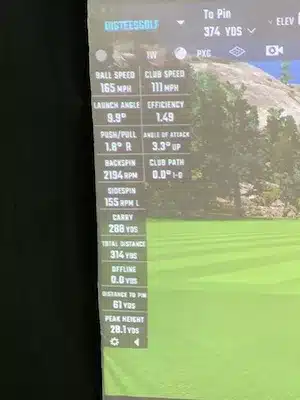
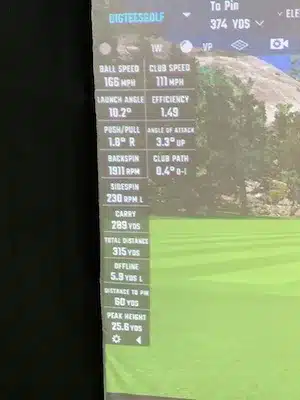
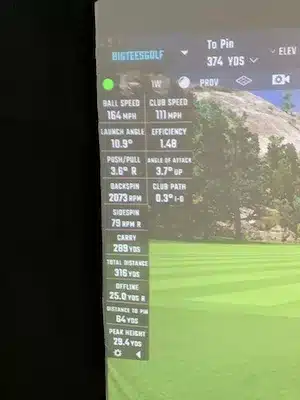
At a glance the three best shots look nearly identical. The interesting detail is in the dispersion. I hit the PXG perfectly on line — the shot dot is dead center. Couldn’t have hit it any better than that. The Pro V1 went a couple yards further total but was 25 yards offline from center. Imagine what that Pro V1 would have done down the middle — probably another 6-8 yards of distance from a straighter angle. The Vice Pro landed close to line but I caught it slightly lower on the clubface, which cost a few yards of carry.
Read the data honestly: the PXG’s spin profile made it the straightest ball of the three on my best swings. That’s real performance, not spec-sheet marketing.
What’s Different About the Xtreme Tour and Tour X
PXG released the Xtreme Tour as a 2025 refresh — same 3-piece urethane construction, but they tuned it firmer to compete more directly with the Pro V1. The changes vs the original Xtreme:
- Higher compression (~91) — firmer feel, engineered for higher swing speeds and lower driver spin.
- Same $34.29 price — PXG deliberately kept the pricing aggressive vs Pro V1’s $54.99.
- Reformulated cover for greenside spin — Golfers Authority’s 2026 review notes 3-5 yards more carry than Pro V1 with more roll on fairways for mid-high swing speed testers, though independent lab data (below) tempers that claim.
- Available in white or bright yellow — a small but real differentiator.
The Xtreme Tour X ($39/doz) is a 4-piece variant aimed at 105+ mph swing speeds — think of it as PXG’s Pro V1x competitor. Higher launch, higher compression (~95), same firmer cover as the Tour. National Club Golfer and Golfers Authority both rated it a “potential winner” in the value-tier 4-piece category in 2026 testing.
If you’re 95-105 mph swing speed, the Xtreme Tour is likely the right pick. Above 105 mph, look at the Tour X. Below 90 mph and prioritising feel, the original Xtreme is still the right PXG ball — it’s the softest of the three.
Ball Lab Quality Note: The Diameter Consistency Issue
MyGolfSpy ran the PXG Xtreme Tour through their Ball Lab in June 2026 — that’s a 36-ball manufacturing-quality audit measuring compression symmetry, weight variance, and diameter consistency across three retail-bought boxes. The verdict: C- overall grade, “Not Recommended” — driven almost entirely by the diameter-consistency score.
- Compression symmetry: A-. The one clearly good result. PXG’s cores are consistent.
- Weight variance: passable, tight tolerances.
- Diameter consistency: F. Balls varied enough in diameter that MyGolfSpy flagged it as a manufacturing quality problem. 1 out of 36 balls was out-of-round enough to be classified “bad ball” — a 2.8% failure rate. Overall 97.2% good-ball rate.
What does that mean in practice? A 97.2% good-ball rate is not catastrophic, and 33 balls per dozen playing correctly is fine for club-level play. But golfers spending on a “tour” ball expect the manufacturing rigor of Pro V1 or TP5 — where Ball Lab has consistently graded compression, weight, and diameter all in the A range.
The take: if you’re a mid-handicap amateur, the PXG Xtreme Tour still plays well. If you’re a serious low-handicap player who wants every ball in the dozen to feel and fly identically, the Ball Lab data is a real caveat. This is why we cite it — MyGolfSpy’s testing is genuinely useful information the manufacturer’s website won’t give you.
Note that this specific test was on the Xtreme Tour, not the original Xtreme. The original Xtreme hasn’t been Ball Lab audited to my knowledge as of 2026.
PXG Ball Pros and Cons
✅ Pros
- High-quality 3-piece urethane at ~$34/doz — real cost savings vs Pro V1
- Excellent greenside spin (highest of the three balls I tested)
- Highest ball speed off the driver in my test (163.2 mph vs 161.9 Pro V1)
- Best on-line dispersion in the “best shot” comparison
- Soft, premium feel — 338-dimple design promotes higher launch
- Straight-forward three-ball lineup covers all swing speeds
- PXG Heroes military/first-responder discount available
- Made at same factory as several other value-tier premium balls (SM Global Vietnam)
❌ Cons
- Slightly less driver distance than Pro V1 and Vice Pro at 110 mph in my test
- Higher driver spin (2,010 rpm) means shorter carry vs the low-spin competitors
- MyGolfSpy Ball Lab flagged diameter consistency (F grade) on the Xtreme Tour — a real quality caveat for the tour-tier ball
- Direct-to-consumer only via pxg.com — no in-store availability, no third-party discounters
- Similar performance available for ~$5-10 less/dozen from Vice Pro if brand isn’t a factor
Which PXG Ball for Which Golfer?
| Your profile | Best PXG pick | Why |
|---|---|---|
| Swing speed < 90 mph, values soft feel | PXG Xtreme (original) | Softest of the three; will still hit its full carry potential at slower speeds |
| Swing speed 90-104 mph, wants Pro V1 alternative | PXG Xtreme Tour | Firmer, lower spin off the tee; direct Pro V1 competitor at 60% of price |
| Swing speed 105+ mph, needs a firmer 4-piece | PXG Xtreme Tour X | 4-piece for high-speed compression; Pro V1x alternative |
| Low-handicap player, wants every ball identical | Consider Pro V1 instead | MyGolfSpy Ball Lab diameter caveat on Xtreme Tour matters most to consistency-sensitive players |
| Budget-conscious, brand-agnostic | Consider Vice Pro instead | Similar 3-piece performance for a few dollars less/dozen |
A Note on PXG and the Crosshair Design
The PXG ball’s alignment mark features a crosshair design that’s not just visual — it’s a nod to founder Bob Parsons’s military service. Parsons served in the Marine Corps in Vietnam, and the crosshair callout on the ball is consistent with the naming convention on their clubs (the 0311 iron, the 0341 driver). As a fellow vet, I appreciate the gestures. Thank you for your service, Bob. Small touches like that go a long way with the veteran community.
PXG Heroes — the company’s military and first-responder discount program — carries this through. If you qualify, use it. Applies to balls, clubs, and accessories, usually saves $5/doz on ball orders.
Frequently Asked Questions
Are PXG golf balls as good as Pro V1?
In my launch-monitor test at 110 mph, the original PXG Xtreme matched Pro V1’s ball speed and carry within 1-2 mph and 5-7 yards. Wedge greenside spin was actually higher on the PXG. The Pro V1 was slightly longer off the tee. In real terms: yes, the performance is close enough that most amateurs will play them within a stroke or two per round of each other. The Pro V1 is more consistent from ball to ball (MyGolfSpy Ball Lab grades). The PXG is 40% cheaper.
What’s the difference between PXG Xtreme Tour and Xtreme Tour X?
The Xtreme Tour is a 3-piece urethane ball at compression ~91 aimed at swing speeds up to 104 mph. The Xtreme Tour X is a 4-piece ball at compression ~95 built for 105+ mph swing speeds — higher launch and firmer feel. Same manufacturing process, same cover formulation; the difference is mantle layer count and firmness targeting different players. Tour X is $39/doz vs Tour at $34.29/doz.
How much do PXG golf balls cost in 2026?
$34.29/doz for the original Xtreme and the Xtreme Tour. $39/doz for the Xtreme Tour X. Direct-to-consumer only via pxg.com. PXG Heroes military/first-responder discount typically saves ~$5/doz.
Do PXG balls have a military discount?
Yes — PXG Heroes is the program name. Active-duty, veterans, first responders, and healthcare workers all qualify. Discount is typically ~$5/doz on ball orders and larger percentages on clubs. Enroll via pxg.com/pxg-heroes with your service verification. As a vet, I’ve used it — process is straightforward.
Should the MyGolfSpy Ball Lab F on diameter make me avoid PXG?
Depends on your standard. For low-handicap players who feel differences ball-to-ball, yes — pick a Pro V1 or TP5 where Ball Lab grades are in the A range. For 10+ handicap amateurs, the 97.2% good-ball rate means you’ll get 33 well-formed balls out of a dozen, which is fine for weekend play. The Ball Lab data is real but its practical impact scales with player skill.
Where can I buy PXG golf balls?
Direct-to-consumer only via pxg.com. Not sold through Golf Galaxy, PGA Tour Superstore, Amazon, or other retailers. This is a deliberate PXG business decision — keeps margins in PXG’s control. Downside for buyers: no third-party discounts, no in-store try-before-buy.
Final Verdict
The PXG Xtreme line performs on par with the Pro V1 for meaningfully less money. Wedge spin and best-shot dispersion were actually better for me on the original Xtreme than on either Pro V1 or Vice Pro. Where the PXG comes up short is total driver distance — a few yards behind both competitors — and manufacturing consistency on the Xtreme Tour tier (per MyGolfSpy Ball Lab).
If you’re loyal to the PXG brand, or if greenside spin is a bigger priority than driver total distance, this is a legitimately good ball. If you’re brand-agnostic and looking for the best three-piece urethane ball at the lowest price, I’m still sticking with my Vice Pro — same performance tier, a few bucks less per dozen.
Either way, the PXG Xtreme line has earned its place in the value-premium ball category. It’s a real competitor to Pro V1, not a knockoff.
Related PXG content: PXG Club Fitting Experience and Review | PXG 0317 T Irons Review
Related ball content: Vice Pro vs Pro V1 Head-to-Head | Best Golf Balls for Distance 2026 | Best Cheap Golf Balls