
Last updated: September 5, 2026
⛳️ Our experts spend hours testing golf balls on the launch monitor, on-course, and reading every independent lab report we can find, before recommending anything. When you make a purchase through one of our links, we may earn a small affiliate commission, at no cost to you. Find out more about how we test products.
Quick Verdict: Is the Srixon Soft Feel Worth It?
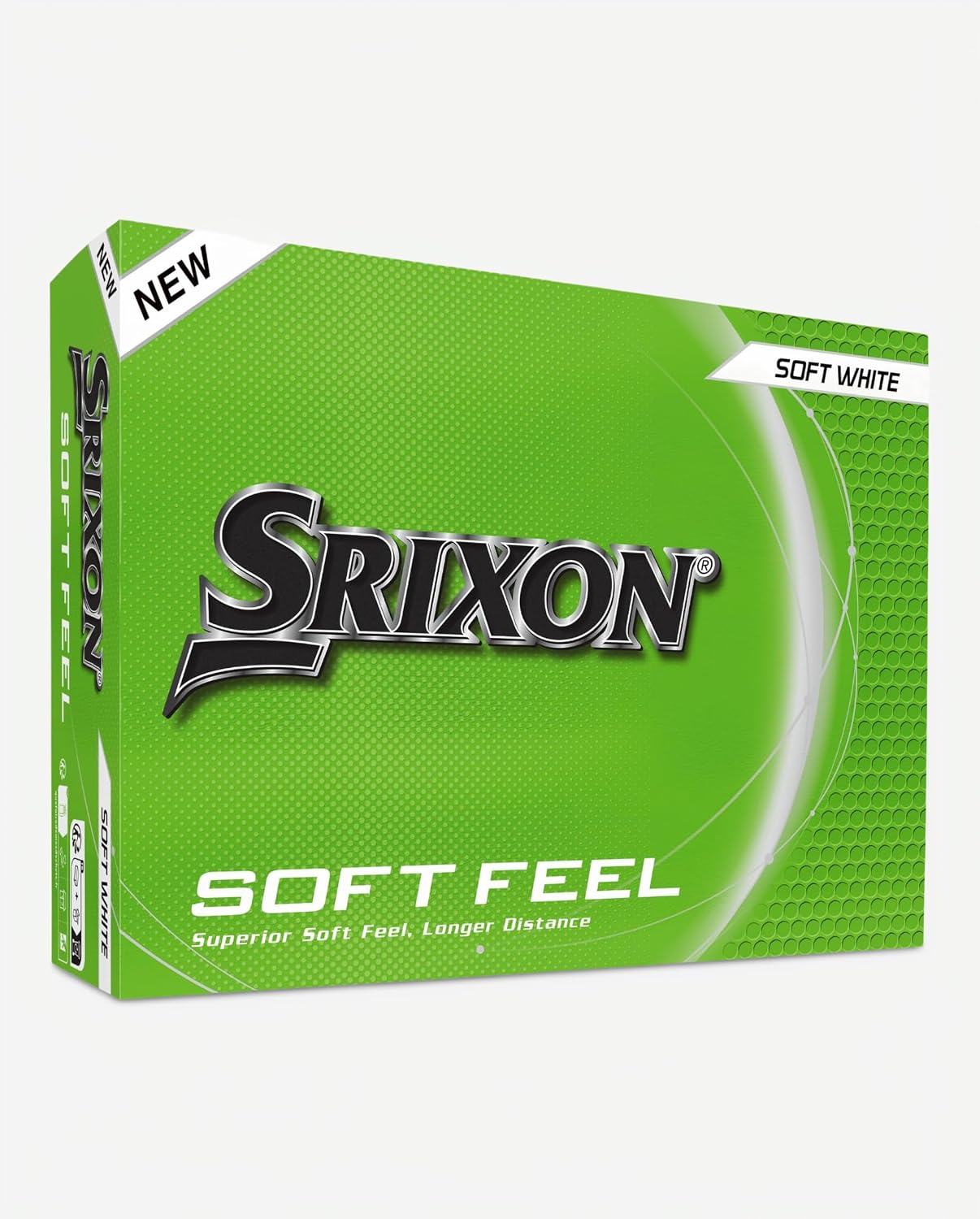
Yes — this is the cheap ball I recommend most often to slow-swing amateurs. The Srixon Soft Feel is a 2-piece ionomer at $17-22 street with a legitimately clever core (Srixon’s FastLayer) and one of the thinnest ionomer covers on the market. Srixon lists compression at 60 — soft-to-mid, softer than the Titleist TruFeel (70) but firmer than the Callaway Supersoft (44) or Wilson Duo Soft (35).
Srixon is owned by Sumitomo Rubber Industries, the Japanese rubber-industry parent behind Dunlop. That engineering pedigree shows up: the FastLayer graduated-firmness core is a real advantage over most 2-piece builds, and the 0.063-inch cover is the thinnest at this price. On my GC3, run head-to-head against Bridgestone e6 Soft and TaylorMade Noodle, the Soft Feel produced better greenside grab than either — not usual for a ball under $22.
Who The Soft Feel Is For (And Who It Isn’t)
Ball fitting maps to swing speed and short-game contact, not handicap. Here is how the Soft Feel maps.
Fits you if:
- Driver swing speed 70-95 mph. The 60-compression core compresses cleanly across the whole band — wider fit than the Supersoft (under 90 mph) or Duo Soft (under 85 mph).
- You want a cheap name-brand ball that isn’t cheaply engineered. $17-22 street with real Japanese engineering most $25-30 competitors don’t match.
- You lose 2+ balls per round. ~$1.50 per ball; a bad round is coffee money.
- Your typical miss is a slice. Low ionomer sidespin tames the curve.
- You’re a slow-swing senior or beginner. Srixon designed the Soft Feel around this demographic — FastLayer graduated firmness helps slower swings find distance.
Wrong ball for you if:
- Driver swing speed 95+ mph. You over-compress the core. Step to Srixon AD333 or a tour ball.
- You need real urethane check. Ionomer is ionomer. Kirkland Signature Performance+ ($17.50 street) is a cheap 3-piece urethane alternative.
- You want the softest feel available. At 60 compression the Soft Feel is soft-mid — Duo Soft (35) and Supersoft (44) feel meaningfully softer.
Construction, Specs, and the FastLayer Core
Srixon’s catalog compression is 60 (58 for the Lady variant). Worth flagging upfront: unlike the TruFeel, Supersoft, Noodle, or Tour Response — where MyGolfSpy Ball Lab has published gauge measurements — MGS has never lab-tested the Soft Feel. The 60 comes from Srixon’s spec sheet, confirmed by MGS launch coverage but not gauge-measured. In the cheap-tier band we do have measured numbers: Duo Soft 35, Supersoft 44, Bridgestone e6 Soft ~40, Noodle 69, TruFeel 70. The Soft Feel sits between the very-soft and mid groups.
The real technical differentiator is the FastLayer core. Most 2-piece ionomer balls have a single-compression core. Srixon engineers theirs with graduated firmness (softer in the middle, progressively firmer toward the outside) via curing-temperature variation rather than physically layered pieces. Practical result: soft impact feel from the softer center, ball-speed retention from the firmer outer. It approximates multi-piece behavior in a 2-piece build, which is why the Soft Feel outperforms most $20 competitors in independent testing.
| Manufacturer | Srixon (Sumitomo Rubber Industries — Japan) |
| Construction | 2-piece: FastLayer graduated-firmness core, thin ionomer cover |
| Cover thickness | 0.063 inches (among the thinnest ionomer covers on the market) |
| Dimples | 338 Speed Dimple Pattern |
| Marketed compression | 60 (standard) / 58 (Lady) |
| MGS measured compression | Not available — no dedicated Ball Lab report exists |
| USGA status | Confirmed conforming |
| Colors | Soft White, Tour Yellow, Brite Red, Brite Orange, Brite Green (matte); Lady in Passion Pink |
| MSRP / dozen | $22.99; typical retail $17-22 |
The 0.063-inch cover matters. Most 2-piece ionomer balls run 0.08-0.10 inches. Srixon makes theirs thinner because a thin cover pinches against the outer core at impact, generating more greenside spin. Not urethane-level, but meaningfully more wedge check than a typical ionomer ball.
Where the Soft Feel Fits in Srixon’s Lineup
| UltiSoft | Soft Feel | AD333 | Q-Star Tour | Z-Star | |
|---|---|---|---|---|---|
| Price / dz | $27 | $22 | $25 | $40 | $45+ |
| Compression | ~45 | 60 | ~70 | 67 (meas.) | 85+ (meas.) |
| Layers | 2-piece | 2-piece | 2-piece | 3-piece | 3-4 piece |
| Cover | Ionomer | Ionomer (thin) | Ionomer | Urethane | Urethane |
| Target speed | Under 80 mph | 70-95 mph | 80-100 mph | 85-105 mph | 95+ mph |
UltiSoft is Srixon’s newer softer sibling (~45 compression) for even-softer feel than the standard. AD333 is the “step up” most Srixon buyers cross-shop — firmer, better distance for 90+ mph swings, still ionomer. If the Soft Feel feels too soft or you’re pushing past 90 mph, AD333 is the next stop. If your short game rewards urethane and you can stretch to $40, Q-Star Tour is the meaningful step-up inside the Srixon family.
My GC3 Simulator Test: Soft Feel vs Bridgestone e6 vs Noodle
I have hit thousands of balls on a Foresight GC3 launch monitor. I ran the Soft Feel head-to-head against the two cheap-tier balls I most often see in the same shopping decision: Bridgestone e6 Soft ($24) and TaylorMade Noodle Long & Soft ($25 for 2 dozen).
- Driver spin: all low. Soft Feel slightly higher than the Noodle but tighter shot-to-shot. Noodle wins absolute lowest spin; Soft Feel wins predictability.
- Distance: essentially equal at moderate swing speeds. e6 Soft marginally fastest, Noodle a small rollout edge, Soft Feel tighter dispersion.
- Mid-iron spin (7-iron): Soft Feel highest of the three — the FastLayer core plus thin cover doing their job. Approach shots hold greens better than a Noodle or e6.
- Greenside spin (56° wedge): Soft Feel wins the group. Thin ionomer cover produces more grab than the Noodle or e6 on chips and pitches. Not urethane-level, but the best in the cheap-tier ionomer field.
On-course, this translates to one specific advantage: chip shots and short pitches from clean lies check up more than a $17 ball has any right to. Not “one hop and stop,” but a noticeable rollout reduction versus a Noodle or Duo Soft. Golflink’s 2026 head-to-head gave the Supersoft the edge on approach-shot stopping power specifically, but on chip and pitch spin the Soft Feel is competitive with anything at this price. Off the tee: straight flight, moderate trajectory, respectable distance for a 60-compression build. Durability tradeoff — the thin cover scuffs faster than thicker ionomer alternatives. Expect one clean round per ball.
Pros and Cons
Pros
- One of the cheapest name-brand balls at $17-22 street
- FastLayer graduated-firmness core (real engineering, not marketing)
- Thin 0.063-inch ionomer cover — better greenside grab than most cheap-tier competitors
- 60 compression fits a wider 70-95 mph band than softer alternatives
- Japanese engineering pedigree (Sumitomo Rubber Industries)
- 5+ color options at the same price
- Highest value score (4.9/5) in the BTG cheap-ball database
Cons
- Not the softest cheap ball (Duo Soft 35, Supersoft 44 both feel softer)
- Supersoft won 3 of 4 categories in Golflink’s 2026 head-to-head, particularly stopping power
- Thin cover scuffs faster than thicker ionomer competitors
- Over-compresses at driver speeds above 95 mph
- No independent MGS Ball Lab report to verify QC consistency
- Basic alignment aid (no Triple Track equivalent)
How the Soft Feel Stacks Up Against 3 Competitors
Srixon MSRP is $22.99 per dozen; typical retail runs $17-22 at Amazon, PGA Tour Superstore, Golf Galaxy, and direct from Srixon. Buy 2- or 3-dozen packs for the best per-ball pricing. The three balls to cross-shop against it — same price band, same intended audience:
Callaway Supersoft — softer feel, better stopping power
Softer at 44 measured, largest color selection in the category. Golflink’s 2026 head-to-head found Supersoft won 3 of 4 categories vs Soft Feel, particularly on stopping power. Tradeoff: MGS Ball Lab gave the 2026 Supersoft a C for compression consistency (13.5-point spread per dozen). Pick Supersoft for softest feel plus colors; pick Soft Feel for engineering credibility and best-in-class value.
Titleist TruFeel — better iron carry, $30
Firmer at MGS-measured 70 compression, better iron carry (ranked 3rd in MGS’s 2026 field at 85 mph), and Titleist Ball Plant 2 QC beats the Soft Feel. $30 vs $22. Pick TruFeel for the brand and iron-carry performance; pick Soft Feel for softer feel and lower price.
Wilson Duo Soft — genuinely the softest, at same price
35 measured — the softest 2-piece ball on the market. $25/dozen. Better fit than Soft Feel under 80 mph; over-compresses above 90 mph where Soft Feel still plays cleanly. Pick Duo Soft for a genuinely slow swing wanting max softness; pick Soft Feel for the 80-95 mph range and the wider fit band.
Frequently Asked Questions
Is the Srixon Soft Feel any good?
Yes, for driver swings of 70-95 mph looking for a real-value cheap ball. The FastLayer graduated-firmness core is a genuine engineering advantage, and the thin 0.063-inch cover produces more greenside grab than any competitor near this price. At $17-22 street, one of the best value picks in the cheap-tier soft-feel category.
What is the compression of the Srixon Soft Feel?
Srixon lists 60 for the standard Soft Feel and 58 for the Lady. Unlike the Supersoft, TruFeel, or Duo Soft — where MGS Ball Lab has published gauge numbers — there is no dedicated MGS report for the Soft Feel. The 60 comes from Srixon’s spec sheet, confirmed by MGS launch coverage but not gauge-measured.
What swing speed is the Soft Feel designed for?
Driver swing speeds 70-95 mph. Wider fit window than the ultra-soft alternatives (Duo Soft and Supersoft best under 90 mph). Above 95 mph the soft core over-compresses — step up to Srixon AD333 or a mid-tier ball.
Srixon Soft Feel vs Callaway Supersoft — which is better?
Different priorities. Supersoft is softer (44 vs 60 catalog), has more colors, and won 3 of 4 categories in Golflink’s 2026 head-to-head including stopping power. Soft Feel is cheaper, fits a wider swing-speed band, and has FastLayer engineering the Supersoft doesn’t match. MGS gave the 2026 Supersoft a C for compression consistency; Soft Feel has never been lab-tested. Pick Supersoft for softest feel and stopping power; pick Soft Feel for best value and wider fit.
What is the difference between Srixon Soft Feel and Srixon AD333?
AD333 is firmer (~70 compression), designed for 80-100 mph swings, and costs $3-5 more per dozen. Both are 2-piece ionomer. Soft Feel prioritizes softer feel and value; AD333 prioritizes better distance at faster swings. Under 90 mph, Soft Feel is the better fit; 90-100 mph, AD333.
How durable is the Srixon Soft Feel?
Moderate. The thin ionomer cover that gives the ball its greenside grab also scuffs faster than thicker covers. Expect one clean round per ball on courses without cart-path grinds. At $17-22 per dozen, that per-round cost is minimal.
Final Verdict
The Srixon Soft Feel is my default cheap-ball recommendation for a specific reader: slow-to-moderate driver swing (70-95 mph), wants value pricing plus real engineering, moderately soft feel without going marshmallow. At $17-22 street you get FastLayer graduated-firmness core technology and one of the thinnest ionomer covers on the market.
Honest caveats: not the softest ball on the market, Golflink’s 2026 head-to-head gave Supersoft the edge on stopping power specifically, and the thin cover scuffs faster than alternatives. My GC3 test backs the reviewer consensus — Soft Feel produces more greenside grab than the Noodle or e6, plus better mid-iron spin than either. Real technical advantage at this price, and it earns the recommendation year after year.
Related: Best Cheap Golf Balls 2026 | Best Golf Balls for Seniors | Callaway Supersoft Review | GC3 Launch Monitor